
Medical Education in the Age of AI: Shaping Technologically Literate yet Humanistic Doctors
Editorial Letter
DOI:
https://doi.org/10.33005/jdiversemedres.v3i7.362Keywords:
Artificial Intelligent, AI Integration, AI Literacy, Medical Education, Medical techonologyAbstract
Preamble
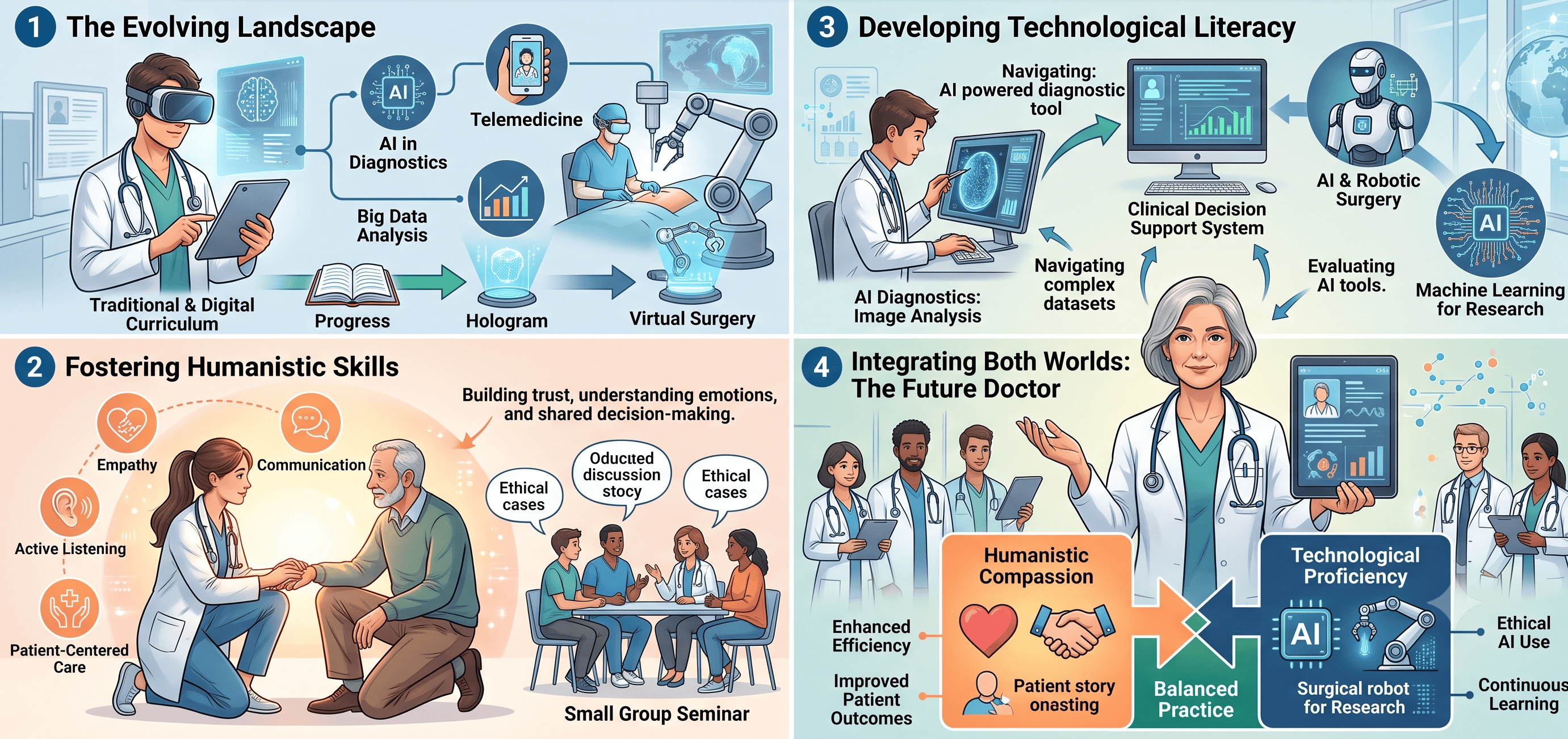
A fundamental question facing medical educators today is this: How do we prepare future doctors for a world where artificial intelligence is reshaping every aspect of clinical practice, without losing the humanistic core that defines the art of medicine? This is no longer a theoretical debate it is an urgent pedagogical imperative.
As Editor-in-Chief and Deputy Editor-in-Chief of Medicosphere, we believe this question demands our immediate attention. AI is rapidly transforming healthcare reshaping clinical decision-making, diagnostic imaging, and patient care. Deep learning algorithms have demonstrated remarkable performance in tasks such as image classification, leading to improved diagnostic accuracy. Yet, paradoxically, at the very moment when technology offers unprecedented capabilities, the need for distinctly human qualities in medicine empathy, compassion, ethical reasoning, and clinical wisdom has never been greater. The challenge before us is clear: we must train doctors who are not only technologically literate but also deeply humanistic. This is not an either‑or proposition. It is both.
Downloads
References
Mendes JM. Reimagining healthcare education through nurturing AI-driven innovation. BMC Med Educ 2025;25(1):1644; doi: 10.1186/s12909-025-08254-9.
Saroha S. Artificial Intelligence in Medical Education: Promise, Pitfalls, and Practical Pathways. Adv Med Educ Pract 2025;16:1039–1046; doi: 10.2147/AMEP.S523255.
Ahsan Z. Integrating artificial intelligence into medical education: a narrative systematic review of current applications, challenges, and future directions. BMC Med Educ 2025;25(1):1187; doi: 10.1186/s12909-025-07744-0.
Janeiro AE, Pereira KP, Mayol J, et al. AI Integration in Spanish Undergraduate Medical Education: National Cross-Sectional Study. JMIR Med Educ 2026;12:e88511; doi: 10.2196/88511.
Rujito L, Muhaimin A, Pergodi MA, et al. Understanding AI adoption in medical education: Insights from students and faculty members in Indonesian medical schools. J Educ Health Promot 2026;15(1):121; doi: 10.4103/jehp.jehp_580_25.
Cai C, Duell J, Minghui Chen D, et al. Advancing AI Literacy in Medical Education: A Medical AI Competency Framework Development. In: Lecture Notes in Computer Science. (Cristea AI, Walker E, Lu Y, et al. eds) Springer Nature Switzerland: Cham; 2025; pp. 116–123; doi: 10.1007/978-3-031-98462-4_15.
Gong M, Pan H, Liu H, et al. Expert Consensus on the Artificial Intelligence Proficiency Competency List and Assessment Framework for Medical Students (2025 Edition). Acta Acad Med Sin 2026;48(1):12–23; doi: 10.3881/j.issn.1000-503X.17210.
Fedorchenko Y, Zimba O. Ethical Use of Artificial Intelligence for Processing Medical Images. J Korean Med Sci 2025;40(48); doi: 10.3346/jkms.2025.40.e341.
Stanford AI in Medical Education: Curriculum and Teaching Resources. AAMC. 2026.
AI curriculum to be introduced in the Medicine Programme. Uppsala University. 2025.
FK KMK UGM Perluas Akses Pendidikan Kesehatan. UGM. 2025.
UIB Gelar Pelatihan Dosen Bersama Nasco Healthcare. UIB. 2025
Downloads
Published
How to Cite
Issue
Section
License
Copyright (c) 2026 Journal of Diverse Medical Research : Medicosphere

This work is licensed under a Creative Commons Attribution 4.0 International License.
CC Attribution 4.0





 This journal applies the Creative Commons Attribution 4.0 International License (CC BY 4.0), which permits unrestricted use, distribution, and reproduction in any medium, provided the original author and source are properly credited.