
Exploration of Alpha-Curcumene and Curdione from Turmeric (Curcuma longa L.) to MurB Enzyme as Antibacterial through Molecular Docking Analysis
Original/Research Article
DOI:
https://doi.org/10.33005/jdiversemedres.v3i7.354Keywords:
curdione, molecular docking, MurB enzymeAbstract
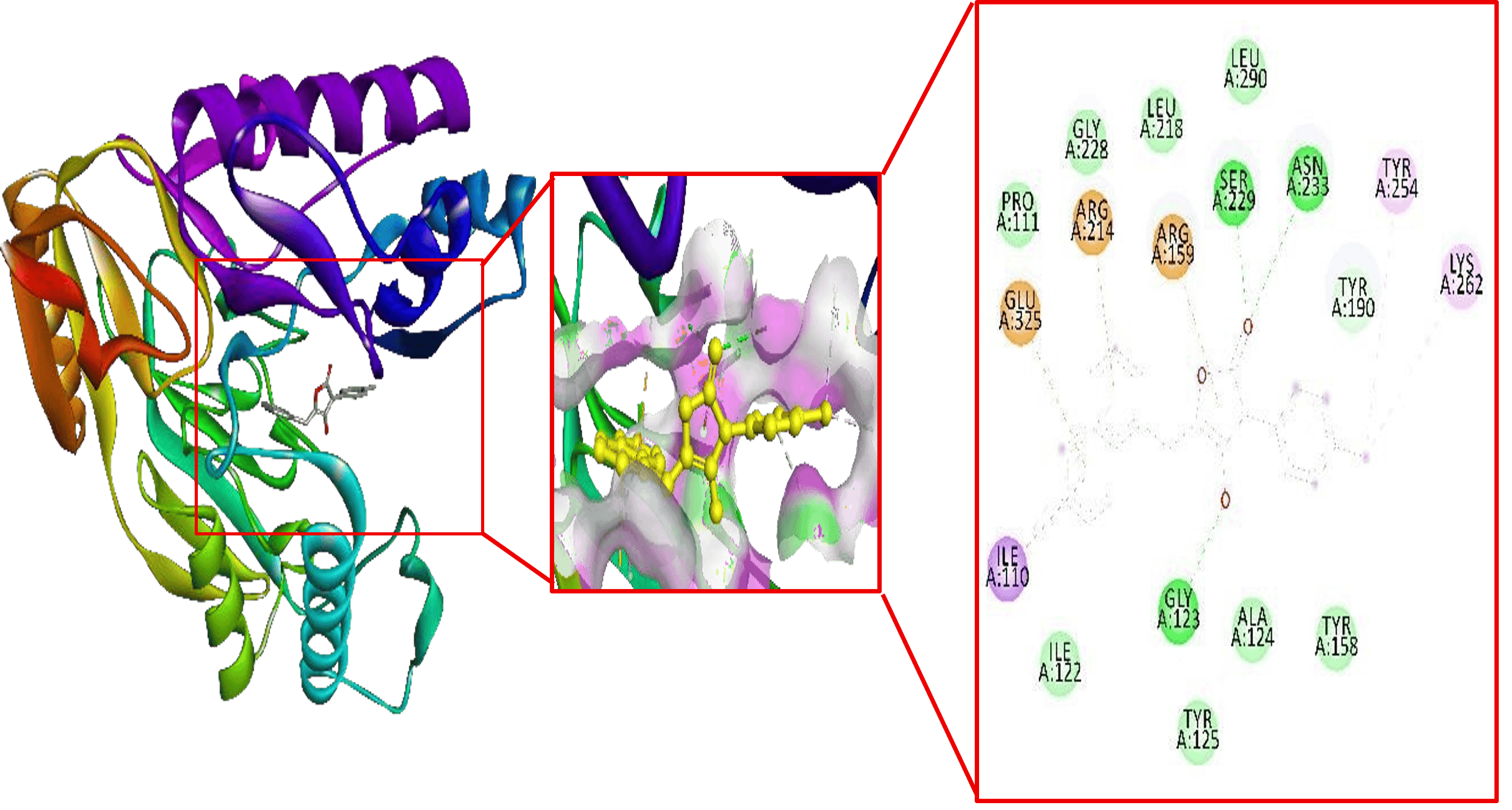
Antimicrobial resistance (AMR) has emerged as a critical global health threat, necessitating the discovery of antibacterial agents with novel mechanisms of action. MurB, an essential enzyme in bacterial cell wall biosynthesis, represents an attractive target due to its absence in humans. This study aimed to evaluate the in silico antibacterial potential of α-curcumene and curdione, two bioactive constituents of turmeric essential oil, as inhibitors of the MurB enzyme. The three-dimensional structure of MurB was retrieved from the Protein Data Bank. The chemical structures of α-curcumene and curdione were obtained from the PubChem database. Molecular docking was performed using AutoDock Vina, with naphthyl tetronic acid (co-crystallized ligand) as a positive control. Binding affinities and interaction profiles were analyzed using PyMOL and Discovery Studio Visualizer. The native ligand exhibited a binding energy of -8.6 kcal/mol. Curdione demonstrated a binding energy of -6.7 kcal/mol, while α-curcumene showed -5.9 kcal/mol. Both compounds docked within the catalytic pocket, interacting with key residues Glu325, Ser229, and Arg159. Curdione exhibited superior binding affinity compared to α-curcumene. Although both compounds showed weaker binding affinity than the native ligand, their ability to occupy the MurB active site suggests they are promising lead scaffolds for antibacterial drug development. Further in vitro and in vivo studies are warranted to validate their biological activity.
Downloads
References
World Health Organization. Antimicrobial resistance [Internet]. Geneva: World Health Organization; 2023 [cited 2026 Jul 3]. Available from: https://www.who.int/news- room/fact-sheets/detail/antimicrobial-resistance
Murray CJL, Ikuta KS, Sharara F, Swetschinski L, Robles Aguilar G, Gray A, et al. Global burden of bacterial antimicrobial resistance in 2019: a systematic analysis. Lancet. 2022;399(10325):629-655. doi:10.1016/S01406736(21)02724-0.
Halawa HM, et al. Antibacterial agents and mechanisms of action in combating bacterial resistance. J Infect Public Health. 2024.
Kurniawan I, Rohmatika AU. Molecular Docking, QSAR, and Bioactivity Prediction of Uncaria gambir Flavonoids as Antibacterial Agents Targeting MurA Enzyme. Biointerface Res Appl Chem. 2026;16(1):1–22.
Kurniawan I, Winarno NS. Unlocking Antibacterial Potential: Thiophene-2-carbaldehyde Modification of Acertannin from African Leaves as MurA Enzyme Inhibitors. J Ners. 2025;9(4):7602–12.
Sharifi-Rad J, et al. Curcuma longa L.: traditional uses, phytochemistry, and pharmacological activities. Phytother Res. 2020.
National Center for Biotechnology Information. PubChem Compound Summary for α-curcumene (CID: 5317512) [Internet]. Bethesda (MD): National Library of Medicine; [cited 2026 Jul 3]. Available from: https://pubchem.ncbi.nlm.nih.gov/compound/5317512
National Center for Biotechnology Information. PubChem Compound Summary for curdione (CID: 6431500) [Internet]. Bethesda (MD): National Library of Medicine; [cited 2026 Jul 3].Available from: https://pubchem.ncbi.nlm.nih.gov/compound/6431500
RCSB Protein Data Bank. Crystal structure of uridine diphosphate-Nacetylenolpyruvoylglucosamine reductase (MurB) (PDB ID: 1HSK) [Internet]. Research Collaboratory for Structural Bioinformatics; [cited 2026 Jul 3]. Available from: https://www.rcsb.org/structure/1HSK
Zhou Y, et al. Bacterial cell wall biosynthesis as a target for antibiotic development. Front Microbiol. 2022.
Kurniawan I. Analisis Penambatan Molekuler Turunan Senyawa Tanin Daun Afrika (Vernonia amygdalina Del) terhadap MurA sebagai Antibakteri. Bogor (ID): IPB University; 2021.
Sanad SMH, Ahmed AAM, Mekky AEM. Synthesis, in-vitro and in-silico study of novel thiazoles as potent antibacterial agents and MurB inhibitors. Arch Pharm (Weinheim). 2020;353(4).
Haque MA, Singh M, Tripathi MK, Ethayathulla AS, Kaur P. Identification of natural small molecule modulators of MurB from Salmonella enterica serovar Typhi Ty2 strain using computational and biophysical approaches. Proteins Struct Funct Bioinforma. 2023;91(3):363–79
Krishna P, Subhan A, Gupta K, Biharee A, Thareja S. Natural Products in the 21st Century: Revolutionizing Therapeutics With Flavonoids as Key Phytometabolites. Phyther Res. 2025;39(9):3833–67.
Ciobanu N, Sucman N, Petrou A, Gorincioi E, Valica V, Uncu L, et al. Biological and Computational Study of the Dual Antimicrobial and Anticancer Potential of 3,4-Dihydropyrimidin-2(1H)-ones and Thiones. ChemistrySelect. 2025;10(26).
Agrahari B, Chaudhary K, Dewan S, Sonker H, Arjun S V., Chandra A, et al. Theragnostic Dual-Action Platform: Ruthenium p-Cymene-Derived Metalloantibiotics With NIR-II Photoacoustic Spectral Signal. Small. 2025;21(26).
Ribeiro J, Silva V, Igrejas G, Barros L, Heleno SA, Reis FS, et al. Phenolic Compounds from Pyrus communis Residues: Mechanisms of Antibacterial Action and Therapeutic Applications. Antibiotics. 2025;14(3):280.
Downloads
Published
How to Cite
Issue
Section
License
Copyright (c) 2026 Journal of Diverse Medical Research : Medicosphere

This work is licensed under a Creative Commons Attribution 4.0 International License.
CC Attribution 4.0





 This journal applies the Creative Commons Attribution 4.0 International License (CC BY 4.0), which permits unrestricted use, distribution, and reproduction in any medium, provided the original author and source are properly credited.