
From Illusion of Competence to Cognitive Debt: Confronting AI Hallucination and Dependency in Medical Student
Editorial Letter
DOI:
https://doi.org/10.33005/jdiversemedres.v3i10.399Keywords:
Artificial intelligence, citation fabrication, cognitive debt, medical education, scientific integrityAbstract
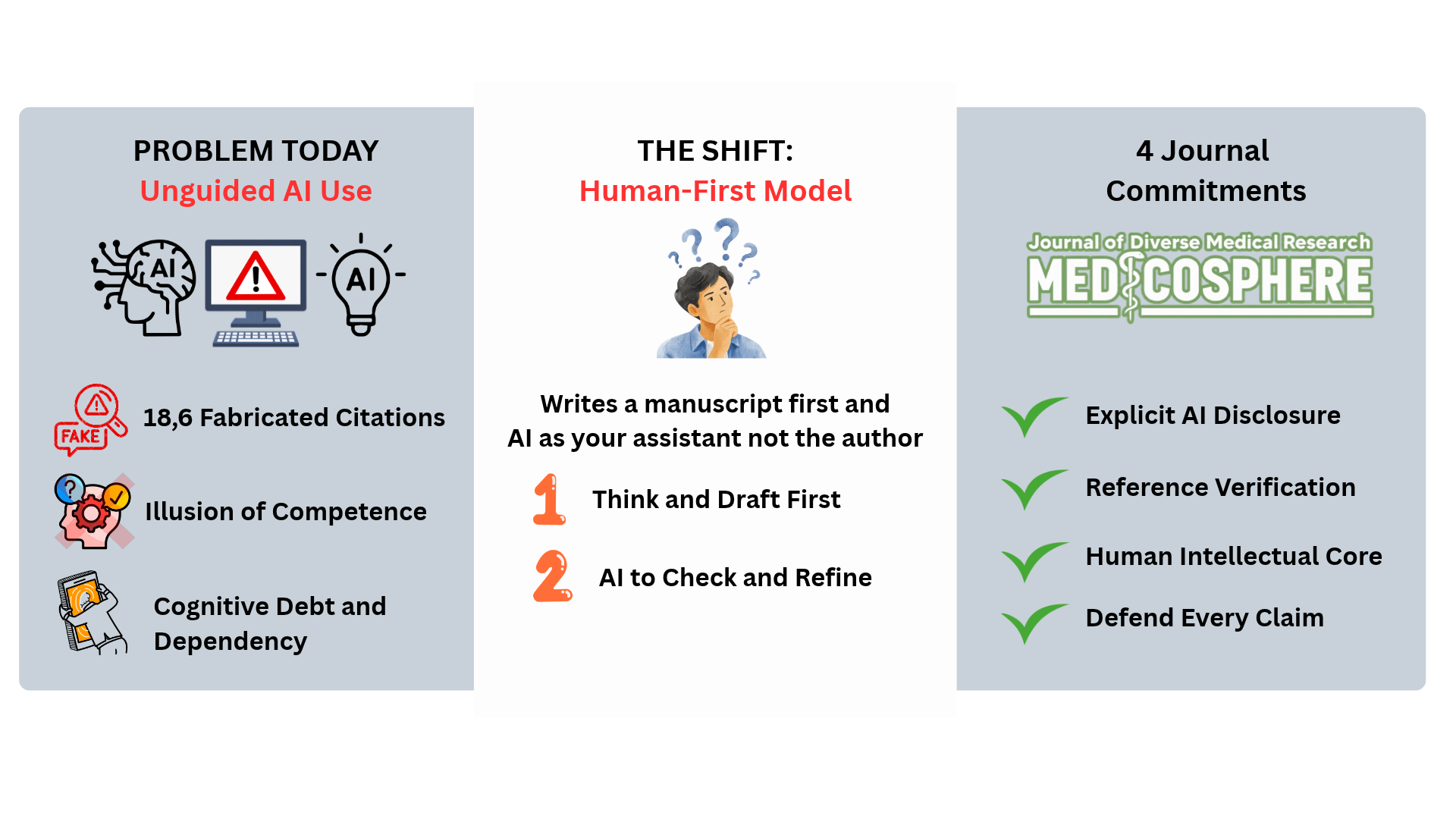
The pages of Journal of Diverse Medical Research: Medicosphere have always been a space where medical students learn to think on paper to wrestle a clinical question into a coherent argument, to trace a claim back to its source, to discover that writing is not the transcription of thought but its formation. That space is now being quietly reshaped. Generative artificial intelligence has entered the writing process not as an occasional aid but as a default first responder: the first draft, the first summary, the first reference list. The concern that brings us to this editorial is not that AI exists, nor that students use it. It is that the line between assistance and substitution has blurred and that blurred line is producing a generation of scholarly work marked by fluent falsehood and a deepening dependency that students themselves are beginning to notice.
Downloads
References
Alazzawi M, Lam K. Uptake of Large Language Models by London Medical Students: Exploratory Qualitative Interview Study. JMIR Form Res 2026;10:e82828; doi: 10.2196/82828.
Malikian R. Fabricated and inaccurate citations generated by large language models for biomedical topics: a systematic review and meta-analysis. Zenodo 2026; doi: https://doi.org/10.5281/zenodo.23584772.
The Royal College of Surgeons of England. More than a third of medical references generated by some AI platforms may be fabricated, new study finds [Internet]. London: The Royal College of Surgeons of England; 2026 Apr 14 [cited 2026 Nov 15]. Available from: https://www.rcseng.ac.uk/news-and-events/media-centre/press-releases/ai-chatbots-paper-2026/
Tenajas R, Miraut D. Rapid response: When and how to use AI in studying medicine: insights from cognitive research. BMJ 2025;390:r1418/rr-4. doi: 10.1136/bmj.r1418.
Abdelhafiz AS, Farghly MI, Sultan EA, et al. Medical students and ChatGPT: analyzing attitudes, practices, and academic perceptions. BMC Med Educ 2025;25(1):187; doi: 10.1186/s12909-025-06731-9.
Tazelaar HD, Aubry M-C, Roden AC, et al. In Reply. Arch Pathol Lab Med 2026;150(7):499–500; doi: 10.5858/arpa.2026-0139-LE.
International Committee of Medical Journal Editors (ICMJE). Recommendations for the Conduct, Reporting, Editing, and Publication of Scholarly Work in Medical Journals. 2025.
Downloads
Published
How to Cite
Issue
Section
License
Copyright (c) 2026 Journal of Diverse Medical Research : Medicosphere

This work is licensed under a Creative Commons Attribution 4.0 International License.
CC Attribution 4.0








 This journal applies the Creative Commons Attribution 4.0 International License (CC BY 4.0), which permits unrestricted use, distribution, and reproduction in any medium, provided the original author and source are properly credited.