
Peer Reviewer Proccess
Process Insights: Peer Review and Production Workflow
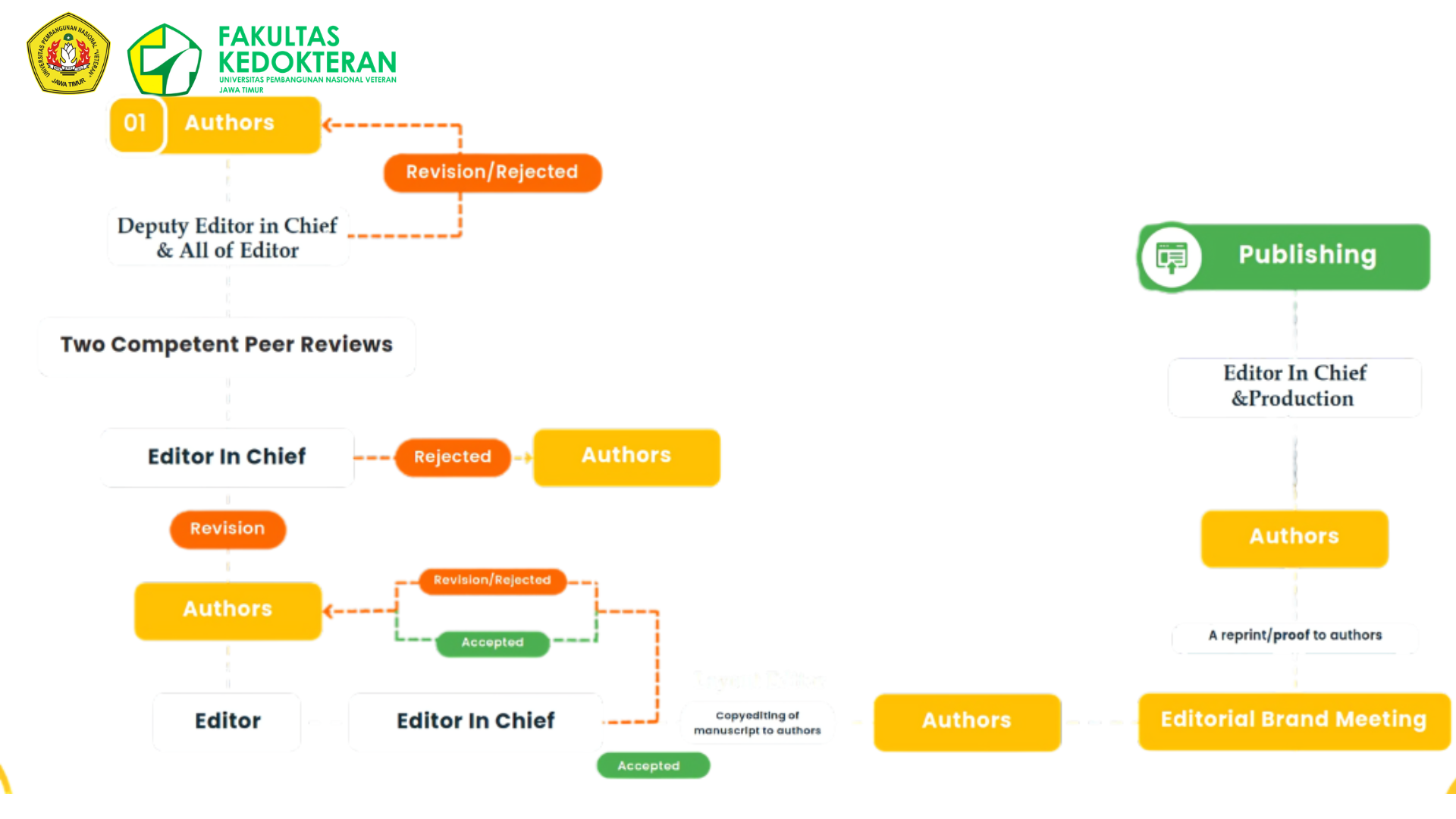
1. Submission
- The author submits the manuscript to the journal through the submission system (OJS platform).
- The manuscript enters the initial assessment phase conducted by the editor.
2. Editorial Check (1 - 7 Day)
- The Editor-in-Chief or editorial team conducts an initial evaluation within 1-7 day to assess:
- Relevance of the manuscript to the journal’s scope.
- Compliance with the journal's policies and formatting requirements.
- Preliminary evaluation of the manuscript’s quality.
- If unsuitable, manuscript may be rejected at this stage.
- If it meets criteria, it proceeds to the peer review phase.
3. Peer Review (2 - 6 Weeks)
- Qualified peer reviewers evaluate the manuscript in 4-6 weeks, considering:
- Originality and contribution to the field.
- Scientific validity and methodology.
- Technical accuracy.
- Suitability of references.
- Clarity and conciseness.
- Ethical compliance and overall quality.
- Reject: Manuscript is declined.
- Accept: Manuscript accepted without revisions.
- Revision Required: Authors revise and resubmit for further review.
4. Editorial Decision (1 - 2 Week)
- After receiving reviewers' feedback, the editorial team makes a final decision within 1-2 week.
- Accept: Manuscript proceeds to production.
- Reject: Manuscript is declined.
- Revise and Resubmit: Authors revise and resubmit for re-evaluation
5. Copy Editing (3 - 7 Days)
- The manuscript undergoes typesetting and formatting to ensure:
- Consistency with the journal’s style.
- Correction of grammatical, typographical, and formatting errors.
- Proper citation and referencing style.
6. Proofreading (5 - 7 Days)
- The edited manuscript is sent to the author for proofreading and final approval.
7. Plagiarism Check (1 - 3 Day)
- A plagiarism check is conducted to ensure originality using plagiarism detection software.
8. Assigned DOI Crossref
- A DOI is assigned and registered with Crossref for citation and referencing.
9. Publication
- After completing all checks, the manuscript is published on the journal's platform.
- Authors are notified of the publication.
Articles accepted by the editorial board into evaluation are subject to blind peer review. In case of dissidence between two referees when evaluating an article, that article is sent to a third referee. If an article is sent to more than two referees, majority opinion is taken as a base. Referees are selected from among the scientific board or academicians from universities. For an article to be published in the journal, it is necessary that referees should state positive opinion.
In articles to be submitted to the journal, the following points are required to be considered:
1. Submitted articles should not have been published elsewhere before and should not be sent to more than one journal at the same time.
2. In studies presented verbally or in poster in any congress, symposium or scientific milieu, name, place and date of the activity should be specified.
3. In studies sponsored by an institution or a fund, name of the sponsor institution and project tag should be given.
4. Information should be given about articles produced from theses. Authors are responsible for mispresentations.
5. For an article to be taken into examination, it should be prepared in accordance with the author guidelines of the Journal of Diverse Medical Research: Medicosphere.
7. For the size of figures, graphs or the like drawings to be included in an article, you can benefit from the archive of the Journal of Diverse Medical Research: Medicosphere.
8. Author/s are responsible for contents of publications, defended opinions, correctness of resources, citations and copyrighted figures and visuals.





 This journal applies the Creative Commons Attribution 4.0 International License (CC BY 4.0), which permits unrestricted use, distribution, and reproduction in any medium, provided the original author and source are properly credited.