
The Efficacy of Nanoliposomes in Cancer Therapy: A Systematic Review of In Vitro Evidence
A Literature Review
DOI:
https://doi.org/10.33005/jdiversemedres.v3i6.351Keywords:
Anticancer, Cancer, in vitro, liposome, nanoliposome, drugs deliveryAbstract
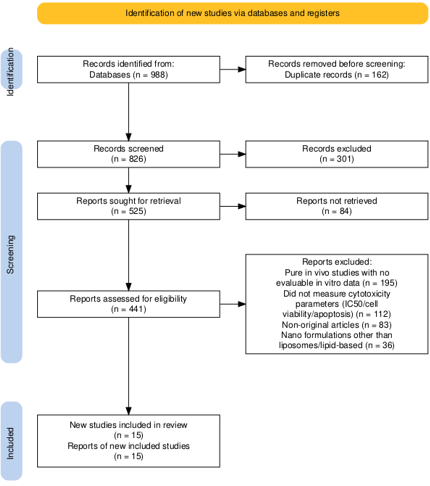
Background: Cancer therapy is frequently limited by suboptimal drug internalization, chemical instability, off-target toxicity, and the rapid emergence of multidrug resistance. Nanoliposomes and related lipid-based nanocarriers offer a promising solution by enhancing the pharmacokinetic and cellular delivery profiles of anticancer agents. Objective: This systematic review critically appraises the available scientific evidence regarding the in vitro efficacy of nanoliposome formulations in cancer therapy. Methods: A systematic literature review (SLR) was conducted following the PRISMA framework across PubMed, Medline, and Google Scholar. From 988 initial records, 441 full-text articles were assessed against predefined eligibility criteria, ultimately yielding 15 original studies for qualitative synthesis. Results: The synthesized data consistently demonstrate that nanoliposome encapsulation significantly enhances the biological performance of anticancer agents compared to free drugs in cell culture models. This enhancement is characterized by markedly reduced IC₅₀ values, decreased cancer cell viability, and increased apoptosis across diverse malignant cell lines. Mechanistically, these improvements are driven by liposome-facilitated active endocytosis, efficient endosomal escape via the Vesicle Budding-and-Collapse (VBC) pathway, and the ability to bypass P-glycoprotein-mediated efflux. Advanced formulations incorporating stimuli-responsive features, genetic payloads (siRNA, mRNA, CRISPR/Cas9), and tumor microenvironment-modifying enzymes demonstrated superior cytotoxic profiles. Conclusion: Nanoliposomes represent a highly functional nanotechnology platform for preclinical cancer intervention, effectively protecting active compounds and facilitating efficient intracellular delivery. However, the inherent limitations of two-dimensional cell cultures which lack the physiological complexity, dynamic tissue barriers, perfusion, and immune interactions of intact organisms necessitate cautious interpretation and further validation in advanced 3D models and in vivo systems.
Downloads
References
Chen YC, Chang LC, Liu YL, Chang MC, Liu YF, Chang PY, et al. Redox disruption using electroactive liposome coated gold nanoparticles for cancer therapy. Nat Commun. 2025;16(1):1-18. doi:10.1038/s41467-025-58636-2. PubMed PMID: 40188189.
Peng C, Jiang B, Lu W, Zalewski P, He J, Li X, et al. Autophagy-mediated suppression of tumor growth by food-grade lipid nanoparticles in mice. Adv Sci. 2025;12(35):2504220. doi:10.1002/advs.202504220. PubMed PMID: 40665665.
Fick K, Kerns N, Zhao Y, Tiamiyu Z, Poschel D, Czabala P, et al. Lipid nanoparticle-delivered IFNα2 activates Cxcl9 to increase T cell tumor recruitment to suppress lung metastasis. J Immunother Cancer. 2025;13(7):e011415. doi:10.1136/jitc-2024-011415. PubMed PMID: 40750105.
Li W, Huang M, Wu Z, Zhang Y, Cai Y, Su J, et al. mRNA-lipid nanoparticle-mediated restoration of PTPN14 exhibits antitumor effects by overcoming anoikis resistance in triple-negative breast cancer. Adv Sci. 2024;11(32):2309988. doi:10.1002/advs.202309988. PubMed PMID: 39189475.
Zhu Y, Wang A, Zhang S, Kim J, Xia J, Zhang F, et al. Paclitaxel-loaded ginsenoside Rg3 liposomes for drug-resistant cancer therapy by dual targeting of the tumor microenvironment and cancer cells. J Adv Res. 2023;49:159-73. doi:10.1016/j.jare.2022.09.007. PubMed PMID: 36167294.
Cheng Z, Huang H, Yin M, Liu H. Applications of liposomes and lipid nanoparticles in cancer therapy: current advances and prospects. Exp Hematol Oncol. 2025;14:1-25. doi:10.1186/s40164-025-00602-1.
Sun G, Wu Y, Li J, Yang M, Xu H, Li Y, et al. Quercetin liposomes conjugated with hyaluronidase: an efficient drug delivery system to block pancreatic cancer. J Control Release. 2025;382:113642. doi:10.1016/j.jconrel.2025.113642. PubMed PMID: 40127723.
Zhang J, Ali K, Wang J. Research advances of lipid nanoparticles in the treatment of colorectal cancer. Int J Nanomedicine. 2024;19:6693-715. doi:10.2147/IJN.S466490. PubMed PMID: 38979534.
Llaguno-Munive M, Vazquez-Lopez MI, Garcia-Lopez P. Solid lipid nanoparticles, an alternative for the treatment of triple-negative breast cancer. Int J Mol Sci. 2024;25(19):10712. doi:10.3390/ijms251910712. PubMed PMID: 39409041.
Xu Y, Wang M, Wu J, Zou M, Wu D, Gong J, Wang P, Yan H, Xia X. Targeted treatment of hepatocellular carcinoma with aptamer-guided solid lipid nanoparticles loaded with norcantharidin. Drug Deliv. 2025;32(1):1-15. doi:10.1080/10717544.2025.1234567.
Zhang Y, Yu R, Zhao C, Liang J, Zhang Y, Su H, et al. CAFs homologous biomimetic liposome bearing BET inhibitor and pirfenidone synergistically promoting antitumor efficacy in pancreatic ductal adenocarcinoma. Adv Sci. 2024;11(1):2305279. doi:10.1002/advs.202305279. PubMed PMID: 37968249.
Zhu C, Wang J, Rahman MdM, Zhang Y, Wang L, Wan Y. Tumor mRNA-lipid nanoparticles via chimeric nanobody-lipid co-assembly. Theranostics. 2025;16(2):651-67. doi:10.7150/thno.123633.
Rong J, Liu T, Yin X, Shao M, Zhu K, Li B, et al. Co-delivery of camptothecin and MiR-145 by lipid nanoparticles for MRI-visible targeted therapy of hepatocellular carcinoma. J Exp Clin Cancer Res. 2024;43(1):1-18. doi:10.1186/s13046-024-03167-9. PubMed PMID: 39215325.
Gamboa L, Zamat AH, Thiveau CA, Lee HJ, Kulaksizoglu E, Zha Z, et al. Sensitizing solid tumors to CAR-mediated cytotoxicity by lipid nanoparticle delivery of synthetic antigens. Nat Cancer. 2025;6(6):1073-87. doi:10.1038/s43018-025-00968-5. PubMed PMID: 40379831.
Masarwy R, Breier D, Stotsky-Oterin L, Ad-El N, Qassem S, Naidu GS, et al. Targeted CRISPR/Cas9 lipid nanoparticles elicits therapeutic genome editing in head and neck cancer. Adv Sci. 2025;12(7):2411032. doi:10.1002/advs.202411032. PubMed PMID: 39736115.
Shuler CF, Safford HC, Thatte AS, Ang M, Mitchell MJ. Examining the effect of lipid nanoparticle elasticity on endocytosis and mRNA delivery to cancer cells. Med-X. 2026;4(1):1-20. doi:10.1007/s44258-026-00082-w.
Pei D. Endosomal escape of lipid nanoparticles: a new perspective on the literature data. ChemRxiv. 2025. doi:10.26434/chemrxiv-2025-v8115.
Li L, He D, Guo Q, Zhang Z, Ru D, Wang L, et al. Exosome-liposome hybrid nanoparticle co-delivery of TP and miR497 conspicuously overcomes chemoresistant ovarian cancer. J Nanobiotechnology. 2022;20(1):1-20. doi:10.1186/s12951-022-01264-5. PubMed PMID: 35078498.
Anthiya S, Öztürk SC, Yanik H, Tavukcuoglu E, Şahin A, Datta D, et al. Targeted siRNA lipid nanoparticles for the treatment of KRAS-mutant tumors. J Control Release. 2023;357:67-83. doi:10.1016/j.jconrel.2023.03.016. PubMed PMID: 36921725.
Xu X, Wang X, Liao YP, Luo L, Nel AE. Reprogramming the tolerogenic immune response against pancreatic cancer metastases by lipid nanoparticles delivering a STING agonist plus mutant KRAS mRNA. ACS Nano. 2025;19(9):8579-94. doi:10.1021/acsnano.4c14102. PubMed PMID: 40025875.
Downloads
Published
How to Cite
Issue
Section
License
Copyright (c) 2026 Journal of Diverse Medical Research : Medicosphere

This work is licensed under a Creative Commons Attribution 4.0 International License.
CC Attribution 4.0





 This journal applies the Creative Commons Attribution 4.0 International License (CC BY 4.0), which permits unrestricted use, distribution, and reproduction in any medium, provided the original author and source are properly credited.