
Meta-Analysis and Systematic Review: Analysis of Antibiotic Residues and Bacteria in Indonesia's Egg and Its Threat to Public Health
A Literature Review
DOI:
https://doi.org/10.33005/jdiversemedres.v3i3.323Keywords:
Antibiotic residue, Chicken eggs, E.coli, Salmonella, Total plate countAbstract
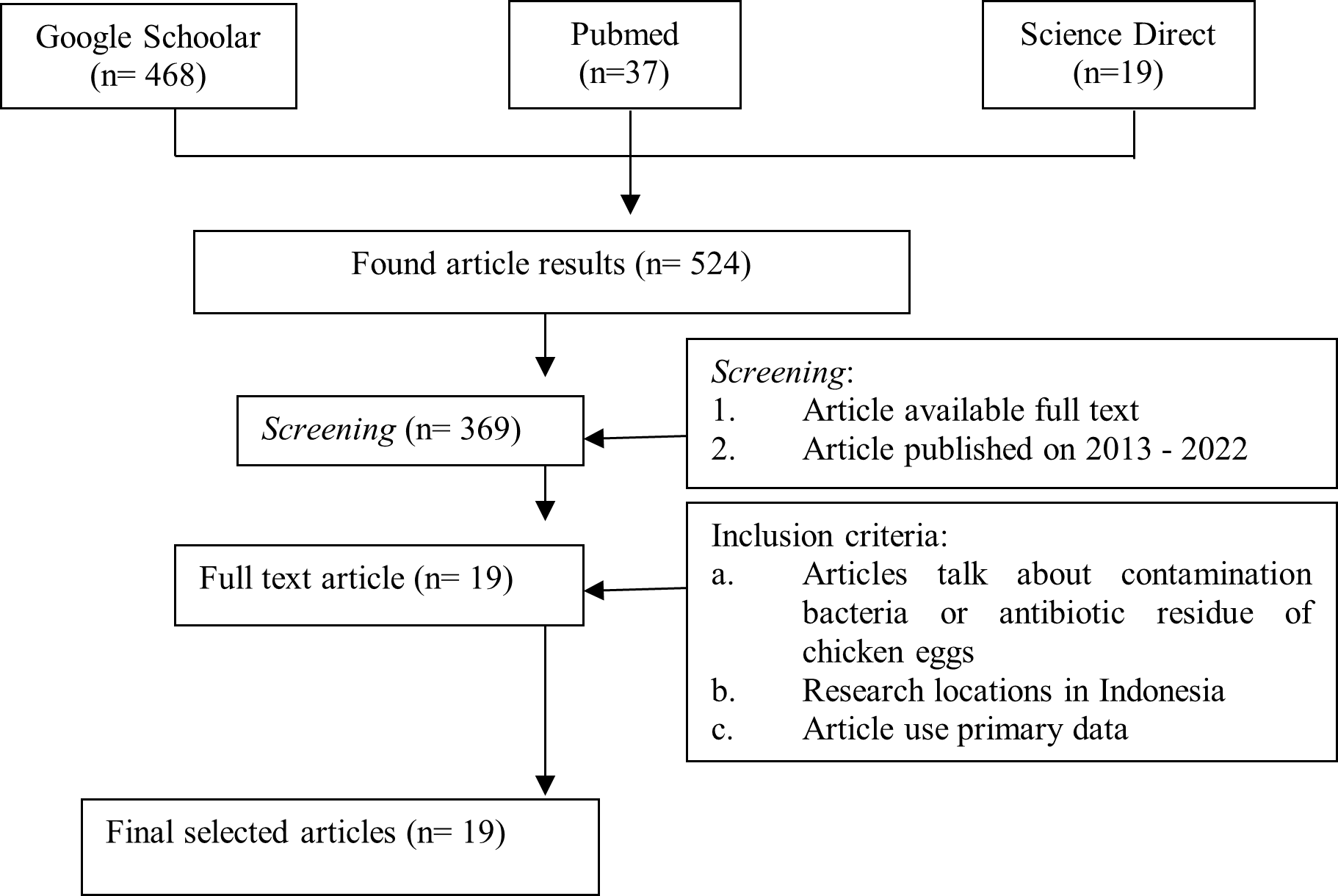
Eggs are the most popular source of protein in Indonesia. The quality of eggs is prone to decline due in management and handling. Eggs can be damaged, one cause of which is microbial growth. Many studies also proved that some eggs sold on the market contain antibiotic residues. The purpose of this study is to determine the presence of antibiotics and bacterial residues on eggs circulating in Indonesia. This study also aims to conduct research on the health risks of eggs containing antibiotic and bacterial residues. This study used meta-analysis and a systematic review. The article search method employs PICO and snowballing techniques across three databases: Google Scholar, ScienceDirect, and PubMed. The articles used are research articles conducted in Indonesia and published between 2012 and 2022. Articles were selected and analyzed as many as 18 articles. This study showed that the findings of bacteria in eggs in Indonesia were OR 0.67 (95% CI 0.52 – 0.88) with a pooled value of OR nial e0.69 = 1.95. Meanwhile, for the OR value of antibiotic residues was 0.28 (95% CI 0.20 – 0.39) with pooled OR e0.28 was 1.32. However, the two results of the study show that there is a bias in the article of the two variables. Consumption of eggs containing antibiotic residues and bacteria can cause various health impacts. In this study, it was found that some eggs in Indonesia contain antibiotic and bacterial residues. Eggs containing antibiotic residues and bacteria can be a threat to public health
Downloads
References
Badan Pusat Statistik. Rata-rata Konsumsi Perkapita Seminggu Menurut Kelompok Telur dan Susu Per Kabupaten/kota (Satuan Komoditas), 2022 [Internet]. 2022. Available from: https://www.bps.go.id/indicator/5/2099/1/rata-rata-konsumsi-perkapita-seminggu-menurut-kelompok-telur-dan-susu-per-kabupaten-kota.html
Wahyuningsih E, Sulisyawati I, Musyarif Z. Identifikasi Bakteri Salmonella sp. pada Telur Ayam Ras yang dijual di Pasar Wage Purwokerto sebagai Pengembangan Bahan Ajar Mikrobiologi. Bioedusiana. 2019;4(24). doi:https://doi.org/10.34289/292827
Mao C, Xue C, Wang X, He S, Wu L, Yan X. Rapid quantification of pathogenic Salmonella Typhimurium and total bacteria in eggs by nano-flow cytometry. Talanta. 2020;217(April):121020. doi:10.1016/j.talanta.2020.121020 PubMed PMID: 32498838.
CDC. Salmonella and Eggs [Internet]. 2023. Available from: https://www.cdc.gov/foodsafety/communication/salmonella-and-eggs.html#:~:text=Salmonella can get on the,can get inside eggs too.
Rikamalia., Rastina. I. Total Staphylococus aureus Pada Telur Ayam Ras Yang Dijual Di Swalayan Kecamatan Syiah K. Jimvet. 2018;2(3):388–95.
Darmayani S, Rosanty A, Vanduwinata V. Identifikasi Bakteri Salmonella sp. Pada Telur yang dijual di Pasar Kota Kendari Provinsi Sulawesi Tenggara. Biog J Ilm Biol. 2017;5(1):21–6. doi:10.24252/bio.v5i1.3429
Mutia Ulfah I, Abrar M. IDENTIFIKASI CEMARAN Escherichia coli PADA TELUR AYAM RAS YANG DIJUAL DI SWALAYAN DAERAH DARUSSALAM KECAMATAN SYIAH KUALA KOTA BANDA ACEH Identification of Escherichia coli Contamination of Race Chicken Eggs that Sold From Minimarket in Darussalam Area of. Jimvet. 2017;01(4):644–9.
Suharyanto, Sulaiman NB, Zebua CKN, Arief II. Kualitas Fisik, Mikrobiologis, dan Organoleptik Telur Konsumsi yang Beredar di Sekitar Kampus IPB, Darmaga, Bogor. J Ilmu Produksi dan Teknol Has Peternak. 2016;4(2):275–9. doi:10.29244/jipthp.4.2.275-279
Syamsiar BI, Santoso KP, Yudaniayati IS, Diyantoro D. Detection of Salmonella sp. on Layer Chicken Eggs Sold at The Vegetable Market of Magetan Regency. J Appl Vet Sci Technol. 2020;1(2):34. doi:10.20473/javest.v1.i2.2020.34-38
Maghfira R, Jamin F, Darniati D, Erina E, Abrar M, Salim MN. PENGARUH SUHU DAN WAKTU PENYIMPANAN TERHADAP PENETRASI Salmonella sp. YANG DIAPLIKASIKAN PADA KERABANG TELUR AYAM RAS. J Ilm Mhs Vet. 2022;6(3):169–76.
Velina Y, Budiman H, Puspitawati L. Salmonella spp: Identifikasinya pada Telur Ayam di Kabupaten Pringsewu Provinsi Lampung. Biosf J Tadris Biol. 2019;10(1):29–37. doi:10.24042/biosfer.v10i1.4280
Cornejo J, Pokrant E, Figueroa F, Riquelme R, Galdames P, Pillo F Di, et al. Assessing antibiotic residues in poultry eggs from backyard production systems in Chile, first approach to a non-addressed issue in farm animals. Animals. 2020;10(6):1–11. doi:10.3390/ani10061056
Aziz A, Dwi Agustin AL, Atma CD. Deteksi Residu Antibiotik Pada Telur Ayam Layer Di Peternakan Ayam Layer Di Sesaot Lombok Barat. VITEK Bid Kedokt Hewan. 2021;11(1):48–52. doi:10.30742/jv.v11i1.75
Agustin ALD. Tingkat Cemaran Bakteri Dan Deteksi Residu Antibiotik Pada Telur Ayam Layer Dari Peternakan Gemas Kabupaten Lombok Utara. J Sangkareang Mataram. 2017;Volume 3(2355):33–5.
Hintono A, Astuti M, Wuryastuti H, Rahayu E. Oxytetracycline Residues and Their Antibacterial Activity in Eggs Laid by Hens Administered by Therapeutic Dose of Oxytetracycline via Drinking Water. J Indones Trop Anim Agric. 2007;32(1):64–70.
Agyare C, Etsiapa Boamah V, Ngofi Zumbi C, Boateng Osei F. Antibiotic Use in Poultry Production and Its Effects on Bacterial Resistance. In: Antimicrobial Resistance - A Global Threat [Internet]. IntechOpen; 2019. Available from: https://www.intechopen.com/books/antimicrobial-resistance-a-global-threat/antibiotic-use-in-poultry-production-and-its-effects-on-bacterial-resistance doi:10.5772/intechopen.79371
WHO. Global Antimicrobial Resistance and Use Serveillance System (GLASS) Report 2022. WHO. Geneva Switzerland; 2022. 2003–2005 p.
Kapena MS, Muma JB, Mubita CM, Munyeme M. Antimicrobial resistance of Escherichia coli and Salmonella in raw retail table eggs in Lusaka, Zambia. Vet World. 2020;13(11):2528–33. doi:10.14202/VETWORLD.2020.2528-2533
Castro-Vargas RE, Herrera-Sánchez MP, Rodríguez-Hernández R, Rondón-Barragán IS. Antibiotic resistance in Salmonella spp. isolated from poultry: A global overview. Vet World. 2020;13(10):2070–84. doi:10.14202/vetworld.2020.2070-2084
M. Sabir, Sarifuddin, Aristo, Ressy Dwiyanti, Andi Nur Asrinawaty. Resistensi Antibiotik terhadap Bakteri Salmonella Typhi: Literature Review. Promot J Kesehat Masy. 2023;13(1):1–6. doi:10.56338/promotif.v13i1.3663
Day JB, Basavanna U, Sharma SK. Development of a cell culture method to isolate and enrich Salmonella enterica serotype enteritidis from shell eggs for subsequent detection by real-time PCR. Appl Environ Microbiol. 2009;75(16):5321–7. doi:10.1128/AEM.02422-08 PubMed PMID: 19561188.
Treiber FM, Beranek-Knauer H. Antimicrobial residues in food from animal origin—a review of the literature focusing on products collected in stores and markets worldwide. Antibiotics. 2021;10(5). doi:10.3390/antibiotics10050534
Ben Y, Hu M, Zhong F, Du E, Li Y, Zhang H, et al. Human daily dietary intakes of antibiotic residues: Dominant sources and health risks. Environ Res. 2022;212(April). doi:10.1016/j.envres.2022.113387 PubMed PMID: 35513060.
Qian J, Wu Z, Zhu Y, Liu C. One Health: a holistic approach for food safety in livestock. Sci One Heal. 2022;1(October 2022):100015. doi:10.1016/j.soh.2023.100015
Arsène MMJ, Davares AKL, Viktorovna PI, Andreevna SL, Sarra S, Khelifi I, et al. The public health issue of antibiotic residues in food and feed: Causes, consequences, and potential solutions. Vet World. 2022;15(3):662–71. doi:10.14202/vetworld.2022.662-671
Downloads
Published
How to Cite
Issue
Section
License
Copyright (c) 2026 Journal of Diverse Medical Research : Medicosphere

This work is licensed under a Creative Commons Attribution-NonCommercial-ShareAlike 4.0 International License.
CC Attribution 4.0





 This journal applies the Creative Commons Attribution 4.0 International License (CC BY 4.0), which permits unrestricted use, distribution, and reproduction in any medium, provided the original author and source are properly credited.