
Association between Poverty Rate and Stunting Prevalence in Central Java
A Narrative Review
DOI:
https://doi.org/10.33005/jdiversemedres.v3i7.365Keywords:
poverty, socioeconomic status, stunting, undernutrition, child growthAbstract
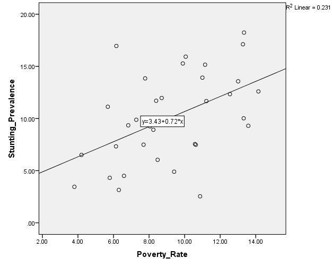
Stunting refers to impaired growth and development in children resulting from chronic nutritional deficiencies, especially during the critical period of the first 1,000 days of life. This study aimed to generate more comprehensive empirical evidence on the association between poverty prevalence and stunting rates among districts and municipalities in Central Java. This study using a quantitative approach, this study analyzed secondary data through a correlational framework. The dataset covered all 36 administrative regions in Central Java Province, where district-level poverty rates and stunting prevalence served as the primary variables of analysis. The relationship between poverty and stunting identified should be interpreted as an association rather than a direct causal link. The findings suggest that poverty contributes to variations in child nutritional status, although it does not fully account for the complexity of underlying determinants. Therefore, poverty should be regarded as an important, yet not exclusive, factor. This study provides evidence of a significant positive association between district-level poverty rates and stunting prevalence in Central Java. The moderate correlation indicates that regions with higher poverty rates are more likely to have elevated stunting prevalence.
Downloads
References
Siramaneerat I, Astutik E, Agushybana F, Bhumkittipich P, Lamprom W. Examining determinants of stunting in urban and rural Indonesia: A multilevel analysis using the Indonesian Family Life Survey (IFLS). BMC Public Health. 2024;24:1371.
Mohamud NA, Feleke A, Worku W, Kifle M, Sharma HR. Urban and rural disparities in stunting among Ethiopian children aged 6–59 months: a multilevel analysis. BMC Public Health. 2020;20(1):1236.
United Nations Children's Fund (UNICEF), World Health Organization, International Bank for Reconstruction and Development/The World Bank. Levels and trends in child malnutrition: UNICEF/WHO/World Bank Group joint child malnutrition estimates. Key findings of the 2025 edition. Geneva: World Health Organization; 2025.
Tim Mitigasi IDI. Update Gizi. Vol. 6, Penatalaksanaan Nutrisi pada Pasien COVID-19. Jakarta: Pengurus Besar Ikatan Dokter Indonesia (PB IDI); 2021.
Randani AI, Baliwati YF, Sukandar D, Tanziha I. Economic and consumption variables and their associations with stunting prevalence: a provincial analysis of the Indonesian Child Nutritional Status Survey 2019. J Gizi Pangan. 2022;17(1):57-66.
Nugroho E, Wanti PA, Suci CW, Raharjo BB, Najib. Social determinants of stunting in Indonesia. J Kesehat Masy (KEMAS). 2023;18(4):546-55.
Yani DI, Rahayuwati L, Sari CWM, Komariah M, Fauziah SR. Family household characteristics and stunting: an updated scoping review. Nutrients. 2023;15(1):233.
Sari DDP, Marwa T, Sukanto, Bashir A. The causality between economic growth, poverty, and stunting: empirical evidence from Indonesia. J Perspekt Pembiayaan Pembang Daerah. 2020;8(1):13-30.
Siddiqui F, Salam RA, Lassi ZS, Das JK. The intertwined relationship between malnutrition and poverty. Front Public Health. 2020;8:453.
Torlesse H, Cronin AA, Sebayang SK, Nandy R. Determinants of stunting in Indonesian children: Evidence from a cross-sectional survey indicating a prominent role for the water, sanitation and hygiene sector. BMC Public Health. 2016;16:669.
Badan Pusat Statistik Provinsi Jawa Tengah. Jumlah dan persentase penduduk miskin menurut kabupaten/kota di Provinsi Jawa Tengah, 2025 [Internet]. Semarang: Badan Pusat Statistik Provinsi Jawa Tengah; 2025 [cited 2026 May 3]. Available from: https://jateng.bps.go.id.
Pemerintah Provinsi Jawa Tengah. Prevalensi stunting kabupaten/kota di Jawa Tengah, 2024 [Internet]. Semarang: Pemerintah Provinsi Jawa Tengah; 2024 [cited 2026 May 5]. Available from: https://jatengprov.go.id.
Sekretariat Wakil Presiden Republik Indonesia. Strategi nasional percepatan pencegahan anak kerdil (stunting) periode 2018–2024. Jakarta: Sekretariat Wakil Presiden Republik Indonesia; 2019.
Kementerian Kesehatan Republik Indonesia. 1000 HPK kunci cegah stunting [Internet]. Jakarta: Kementerian Kesehatan Republik Indonesia; 2024 [cited 2026 Aug 3]. Available from: https://www.kemkes.go.id.
United Nations Children's Fund. Nutrition, for every child: UNICEF nutrition strategy 2020–2030 [Internet]. New York: UNICEF; 2020 [cited 2026 May 7]. Available from: https://www.unicef.org/reports/nutrition-strategy-2020-2030.
Downloads
Published
How to Cite
Issue
Section
License
Copyright (c) 2026 Journal of Diverse Medical Research : Medicosphere

This work is licensed under a Creative Commons Attribution 4.0 International License.
CC Attribution 4.0





 This journal applies the Creative Commons Attribution 4.0 International License (CC BY 4.0), which permits unrestricted use, distribution, and reproduction in any medium, provided the original author and source are properly credited.