
Biopigments from Monascus sp. as Potential Peroxisome Proliferator-Activated Receptor Alpha (PPAR-α) Modulators: A Computational Approach
Original/Research Article
DOI:
https://doi.org/10.33005/jdiversemedres.v3i7.372Keywords:
Biopigments, Lipid Metabolism, Monascus, PPAR-α, RubropunctatinAbstract
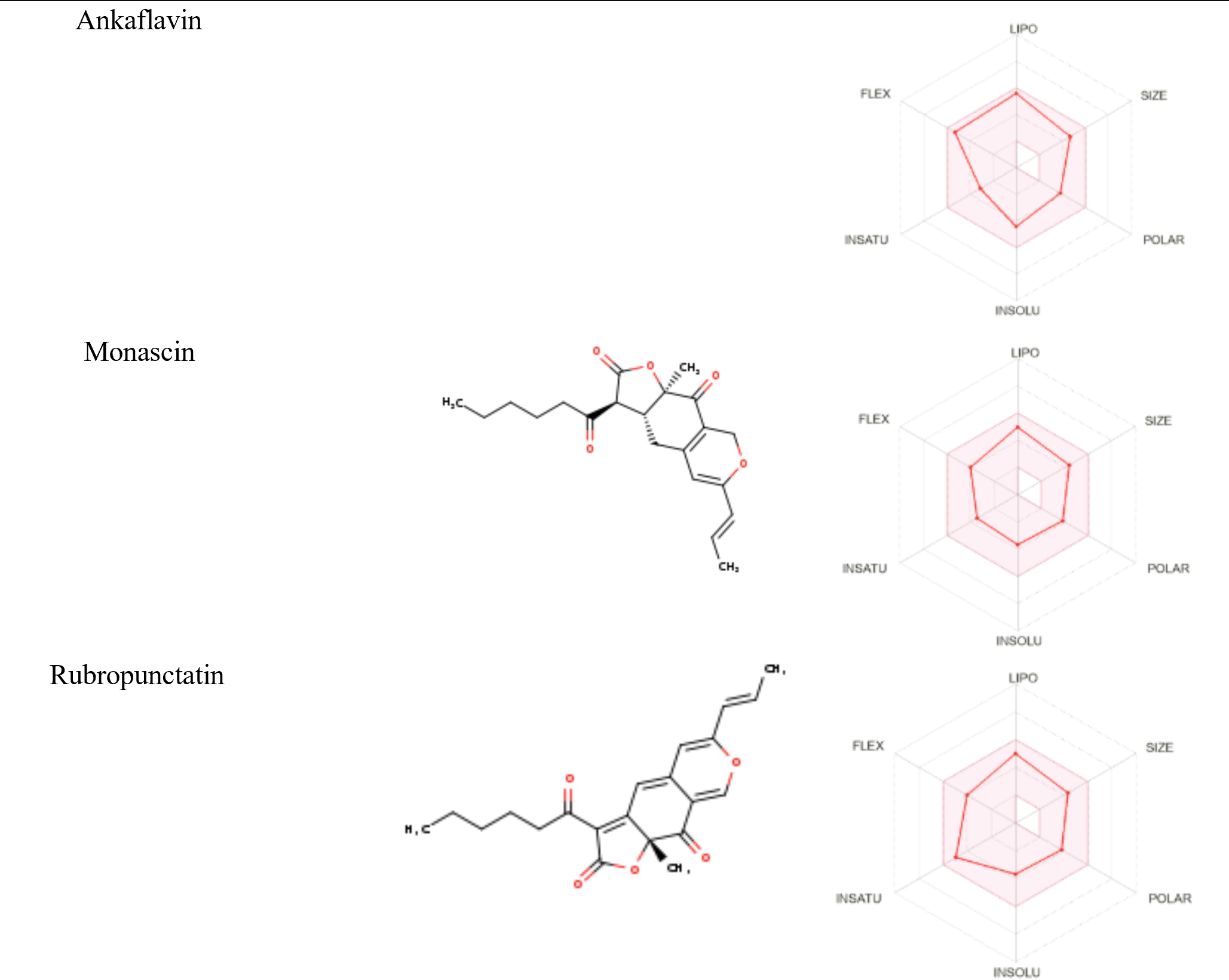
Monascus sp. produces biopigments (ankaflavin, monascin, and rubropunctatin) that have various biological activities, including a role in lipid metabolism through interaction with peroxisome proliferator-activated receptor alpha (PPAR-α). It plays an important role in regulating lipid metabolism and is a therapeutic target. Fenofibrate is one of the antihyperlipidemic drugs that targets PPAR-α. Therefore, this study aimed to evaluate the interaction of ankaflavin, monascin, and rubropunctatin with PPAR-α. The biopigments were analyzed using SwissADME and molecular docking with PPAR-α (PDB ID: 5HYK). The results showed that ankaflavin, monascin, and rubropunctatin complied with Lipinski’s Rule. Molecular docking revealed that all biopigments analyzed had good interactions with PPARα, with binding affinity values of ankaflavin -10.03 kcal/mol, monascin -10.38 kcal/mol, and rubropunctatin -10.62 kcal/mol. Rubropunctatin had the most negative binding affinity and the lowest predicted Ki (16.45 µM) among the tested biopigments and was most similar to the positive control, fenofibrate (−10.78 kcal/mol and 12.59 µM). In conclusion, these findings suggest that biopigments from Monascus sp. are potential candidates for PPAR-α modulators, particularly rubropunctatin. Further in vivo and in vitro investigations are necessary to validate these findings.
Downloads
References
Naser IH, Alkareem ZA, Mosa AU. Hyperlipidemia: pathophysiology, causes, complications, and treatment. A review. Karbala Journal of Pharmaceutical Sciences. 2021. 1(19):118.
Duan Y, Gong K, Xu S, Zhang F, Meng X, Han J. Regulation of cholesterol homeostasis in health and diseases: from mechanisms to targeted therapeutics. Signal transduction and targeted therapy. 2022. 7(1):265.
Li Z, Deng W, Yang L, Tang C, Yue JM, Monteiro O, Baptista-Hon DT, Li T. Lipid metabolism in homeostasis and disease. Signal transduction and targeted therapy. 2026. 11(1):55.
Bougarne N, Weyers B, Desmet SJ, Deckers J, Ray DW, Staels B, De Bosscher K. Molecular actions of PPAR α in lipid metabolism and inflammation. Endocrine reviews. 2018. 39(5):760- 802.
HuP,LiK,PengX,KanY,LiH,ZhuY,WangZ,LiZ,LiuHY,CaiD.Nuclearreceptor PPARα as a therapeutic target in diseases associated with lipid metabolism disorders. Nutrients. 2023. 15(22):4772.
Tahri-Joutey M, Andreoletti P, Surapureddi S, Nasser B, Cherkaoui-Malki M, Latruffe N. Mechanisms mediating the regulation of peroxisomal fatty acid beta-oxidation by PPARα. International journal of molecular sciences. 2021. 22(16):8969.
HeJ,ZhangP,ShenL,NiuL,TanY,ChenL,ZhaoY,BaiL,HaoX,LiX,ZhangS.Short- chain fatty acids and their association with signalling pathways in inflammation, glucose and lipid metabolism. International journal of molecular sciences. 2020. 21(17):6356.
Chaudhary V, Katyal P, Poonia AK, Kaur J, Puniya AK, Panwar H. Natural pigment from Monascus: The production and therapeutic significance. Journal of Applied Microbiology. 2022. 133(1):18-38.
Feng SS, Li W, Hu YJ, Feng JX, Deng J. The biological activity and application of Monascus pigments: A mini review. International Journal of Food Engineering. 2022. 18(4):253-66.
Husakova M, Patakova P. Purified Monascus pigments: Biological activities and mechanisms 9
e-ISSN : 3063-9433 Journal of Diverse Medical Research: Medicosphere 2026; No (Vol)
of action. Journal of Natural Products. 2025. 88(2):607.
Alqurashy NN, Yousef MI, Tabakh MA, Hussein AA, Kamel MA, El-Wakil A. Protective role
of Monascus red pigment against hydroxyapatite nanoparticle-induced liver injury in rats via modulation of metabolic regulators. Biochemical and Biophysical Research Communications. 2025. 775:152179.
Mohankumari HP, Naidu KA, Narasimhamurthy K, Vijayalakshmi G. Bioactive pigments of Monascus purpureus attributed to antioxidant, HMG-CoA reductase inhibition and anti- atherogenic functions. Frontiers in Sustainable Food Systems. 2021. 5:590427.
Liang JX, Zhang QQ, Huang YF, Pang HQ, Liu XG, Gao W, Li P, Yang H. Comprehensive chemical profiling of monascus-fermented rice product and screening of lipid-lowering compounds other than monacolins. Journal of ethnopharmacology. 2019. 238:111879.
Yang PX, Hsu YW, Pan TM, Lee CL. Monascinol from Monascus pilosus-fermented rice exhibits hypolipidemic effects by regulating cholesterol and lipid metabolism. Journal of Functional Foods. 2024. 119:106285.
Agoni C, Fernandez-Diaz R, Timmons PB, Adelfio A, Gomez H, Shields DC. Molecular modelling in bioactive peptide discovery and characterisation. Biomolecules. 2025. 15(4):524.
Arief I, dan Hairunnisa H. Profil ADME Dari Entitas Molekul Baru Yang Disetujui Oleh FDA Tahun 2021: Suatu Kajian In Silico. Jambura Journal of Chemistry. 2022. 4(2):1–11.
Husakova M, Patakova P. Purified Monascus Pigments: Biological Activities and Mechanisms of Action. J Nat Prod. 2025. 28;88(2):607-615. doi: 10.1021/acs.jnatprod.4c01008.
Tahri-Joutey M, Andreoletti P, Surapureddi S, Nasser B, Cherkaoui-Malki M, Latruffe N. Mechanisms mediating the regulation of peroxisomal fatty acid beta-oxidation by PPARα. International journal of molecular sciences. 2021. 22(16):8969.
Hsu WH, Chen TH, Lee BH, Hsu YW, Pan TM. Monascin and ankaflavin act as natural AMPK activators with PPARα agonist activity to down-regulate nonalcoholic steatohepatitis in high- fat diet-fed C57BL/6 mice. Food and Chemical Toxicology. 2014. 64:94-103.
Kamata S, Oyama T, Saito K, Honda A, Yamamoto Y, Suda K, Ishikawa R, Itoh T, Watanabe Y, Shibata T, Uchida K, Suematsu M, Ishii I. PPARα Ligand-Binding Domain Structures with Endogenous Fatty Acids and Fibrates. iScience. 2020. 23(11):101727. doi: 10.1016/j.isci.2020.101727.
Downloads
Published
How to Cite
Issue
Section
License
Copyright (c) 2026 Journal of Diverse Medical Research : Medicosphere

This work is licensed under a Creative Commons Attribution 4.0 International License.
CC Attribution 4.0





 This journal applies the Creative Commons Attribution 4.0 International License (CC BY 4.0), which permits unrestricted use, distribution, and reproduction in any medium, provided the original author and source are properly credited.