
Beyond the Patient: Family-Level Consequences of Cancer on Quality of Life, Productivity, and Economic Stability
A Literature Review
DOI:
https://doi.org/10.33005/jdiversemedres.v3i5.340Keywords:
Cancer, Family, Patient Caregivers, Quality of Life, Economic Burden, ProductivityAbstract
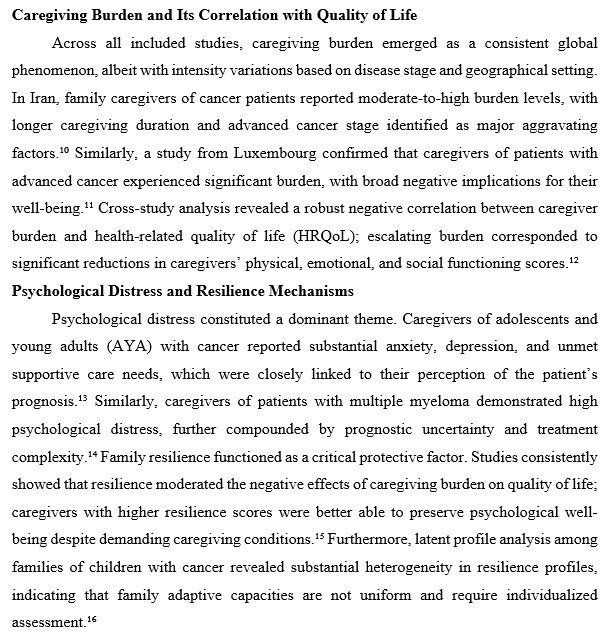
Background: Cancer imposes a substantial global health burden, with consequences extending beyond the individual patient to affect family members who serve as primary caregivers throughout the disease trajectory. Despite growing recognition of caregiver burden, the multidimensional impacts on family quality of life, productivity, and economic stability remain insufficiently addressed in clinical practice and health policy. Objective: This narrative review aims to synthesize current evidence on the impact of cancer on family caregivers, particularly regarding quality of life, psychological well-being, work productivity, and financial stability. Methods: A literature search was conducted using PubMed, ScienceDirect, Springer Nature, Oxford Academic, and Google Scholar for articles published between 2020 and 2026 in English or Indonesian. A combination of Boolean operators (AND, OR) was applied with keywords including cancer, family, caregiver, quality of life, productivity, and financial toxicity. Following title, abstract, and full-text screening, 24 studies met the inclusion criteria and were analyzed using a comparative-critical synthesis approach. Results: The synthesis revealed that caregiving burden is a major determinant of reduced family quality of life, particularly in physical, emotional, and social domains. Psychological distress including anxiety, depression, and fatigue served as a significant mediator between caregiving burden and reduced well-being. Financial toxicity resulting from treatment costs and loss of work productivity further exacerbated these effects, especially in low- and middle-income countries. Conversely, protective factors including family resilience, perceived social support, and high-quality interpersonal relationships were consistently associated with lower perceived burden and better quality of life. Conclusion: Cancer caregiving generates cascading consequences on family well-being, mediated by psychological distress and economic strain. A family-centered care approach that integrates routine caregiver screening, psychosocial support, resilience-building interventions, and financial protection policies is urgently needed to improve outcomes for both patients and their families.
Downloads
References
Hanahan D. Hallmarks of cancer: new dimensions. Cancer Discov. 2022;12(1):31-46.
Bray F, Laversanne M, Sung H, et al. Global cancer statistics 2022: GLOBOCAN estimates of incidence and mortality worldwide for 36 cancers in 185 countries. CA Cancer J Clin. 2024;74(3):229-263.
Sung H, Ferlay J, Siegel RL, et al. Global cancer statistics 2020: GLOBOCAN estimates of incidence and mortality worldwide for 36 cancers in 185 countries. CA Cancer J Clin. 2021;71(3):209-249.
Miller KD, Nogueira L, Devasia T, et al. Cancer treatment and survivorship statistics, 2022. CA Cancer J Clin. 2022;72(5):409-436.
Given BA, Given CW, Sherwood PR. Family and caregiver needs over the course of the cancer trajectory. J Support Oncol. 2012;10(2):57-64.
Mirshahi A, Farsi Z, Sajadi SA, et al. Caregiver burden in family caregivers of individuals with cancer in Iran: an analytical cross-sectional study. J Health Popul Nutr. 2025;44:186.
Cui P, Yang M, Hu H, et al. The impact of caregiver burden on quality of life in family caregivers of patients with advanced cancer: a moderated mediation analysis of the role of psychological distress and family resilience. BMC Public Health. 2024;24:817.
Liu J, Zhang Y, Guan T, et al. Quality of life and appraisal factors of patients with advanced cancer and their family caregivers. Support Care Cancer. 2025;33:471.
Gan GG, Tey KWF, Mat S, et al. Quality of life of family caregivers of cancer patients in a developing nation. Asian Pac J Cancer Prev. 2022;23(11):3905-3914.
Kaddu-Mulindwa D, Jacob F, Schalbar C, et al. Quality of life and burden in family caregivers of advanced cancer patients in the Grand Duchy of Luxembourg: results from a single-centre study. Support Care Cancer. 2026;34:296.
Rostami M, Abbasi M, Soleimani M, et al. Quality of life among family caregivers of cancer patients: an investigation of SF-36 domains. BMC Psychol. 2023;11:445.
Cheng Q, Ng MS, Choi KC, So WK. Unmet needs, anxiety, depression, and quality of life among caregivers of adolescents and young adults with cancer: a cross-sectional study. Asia Pac J Oncol Nurs. 2022;9(10):100108.
O'Donnell EK, Shapiro YN, Yee AJ, et al. Quality of life, psychological distress, and prognostic perceptions in caregivers of patients with multiple myeloma. Blood Adv. 2022;6(17):4967-4974.
Üzar-Özçetin YS, Dursun Sİ. Quality of life, caregiver burden, and resilience among the family caregivers of cancer survivors. Eur J Oncol Nurs. 2020;48:101832.
Li B, Shu D, Pang S, et al. Primary caregiver-reported family resilience in children with cancer in central China: a latent profile analysis. BMC Nurs. 2025;24:1248.
Ogamba CF, Joseph A, Adefemi AK, et al. Factors associated with health-related quality of life and financial toxicity among gynecological cancer patients in Southern Nigeria. Sci Rep. 2025;15:28041.
Veenstra CM, Braun TM, Abrahamse PH, Wittmann D, Hawley ST. Employment outcomes in family supporters of patients with early stage breast cancer and their association with patients' health-related quality of life and financial burden. Cancer Med. 2022;11(5):1324-1335.
Ornstein KA, Wolff JL, Bollens-Lund E, Rahman OK, Kelley AS. Quality of relationships and caregiver burden among caregivers of patients with advanced cancer: a longitudinal study. J Gerontol B Psychol Sci Soc Sci. 2023;79(2):gbad165.
Kim B, Hwang IC, Ahn HY, et al. Family relationships and caregiver burden among family caregivers of patients with terminal cancer. BMC Palliat Care. 2025;24:207.
Hasnani F, Mumpuni M. Pengaruh pendampingan oleh penyintas kanker terhadap motivasi pasien kanker payudara dalam menjalani pengobatan. J Health Sains. 2023;4(1).
Andersson EK, Nilsson J, Ebbeskog B. Two sides of the cancer journey: a qualitative study on the psychosocial supportive care needs in older patients and family caregivers. Eur J Oncol Nurs. 2025;68:1026XX.
Zhang H, Liu Y, Wang X, et al. Factors related to the quality of life of family cancer caregivers. Front Psychiatry. 2023;14:1223456.
Lazarus RS, Folkman S. Stress, appraisal, and coping. New York: Springer; 1984.
Walsh F. Family resilience: a framework for clinical practice. Fam Process. 2003;42(1):1-18.
Bognár SA, Teutsch B, Bunduc S, et al. Psychological intervention improves quality of life in patients with early-stage cancer: a systematic review and meta-analysis of randomized clinical trials. Sci Rep. 2024;14:13233.
Custers PA, van der Sande ME, Grotenhuis BA, et al. Long-term quality of life and functional outcome of patients with rectal cancer following a watch-and-wait approach. JAMA Surg. 2023;158(5):e230146.
Sari NP, Widyawati IY, Haryani H. Kualitas hidup family caregiver pasien kanker dan faktor-faktor yang mempengaruhinya. Media Ilmu Kesehatan. 2022;11(2):167-174.
Yang X, Done N, Cunnington M, et al. Burden among caregivers of adult patients with neurofibromatosis type 1 and plexiform neurofibroma in the United States: a cross-sectional survey study. Neurol Ther. 2026;15(1):XX.
Wolff JL, Spillman BC, Freedman VA, et al. A national profile of family and unpaid caregivers who assist older adults with health care activities. JAMA Intern Med. 2016;176(3):372-379.
Kälin S, Baenziger J, Mader L, et al. Health-related quality of life in parents of long-term childhood cancer survivors: a report from the Swiss Childhood Cancer Survivor Study - Parents. Qual Life Res. 2025;34:1079-1090.
Northouse LL, Katapodi MC, Song L, Zhang L, Mood DW. Interventions with family caregivers of cancer patients: meta-analysis of randomized trials. CA Cancer J Clin. 2010;60(5):317-339.
Zarit SH, Reever KE, Bach-Peterson J. Relatives of the impaired elderly: correlates of feelings of burden. Gerontologist. 1980;20(6):649-655.
Epstein RM, Street RL Jr. Patient-centered communication in cancer care: promoting healing and reducing suffering. Bethesda: National Cancer Institute; 2007.
Downloads
Published
How to Cite
Issue
Section
License
Copyright (c) 2026 Journal of Diverse Medical Research : Medicosphere

This work is licensed under a Creative Commons Attribution 4.0 International License.
CC Attribution 4.0





 This journal applies the Creative Commons Attribution 4.0 International License (CC BY 4.0), which permits unrestricted use, distribution, and reproduction in any medium, provided the original author and source are properly credited.