
Schizoaffective Disorder With Emotional Dependence and Psychosomatic Symptoms : A Case Report and A Biopsychosocial Approach
A Case Report and A Biopsychosocial Approach
DOI:
https://doi.org/10.33005/jdiversemedres.v3i6.312Keywords:
schizoaffective disorder, emotional dependence, Psycomatic, biopsychosocial, family therapyAbstract
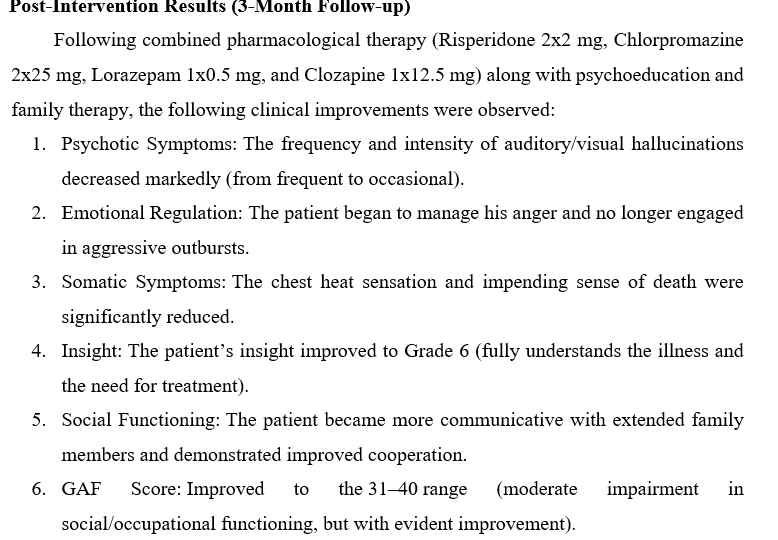
Background: Schizoaffective disorder is a complex psychiatric condition characterized by the concurrent presence of psychotic symptoms and mood disturbances. Cases presenting with pronounced emotional dependence on family members and prominent psychosomatic manifestations are infrequently documented in Indonesia, posing diagnostic and therapeutic challenges. Case Presentation: A 36-year-old unmarried male presented with a 10-year history of uncontrolled emotions, auditory and visual hallucinations, persistent fear, chest heat sensation, and an impending sense of death. Symptoms were exacerbated when anticipating separation from his parents. The patient had experienced occupational decline, marital dissolution due to aggressive behavior, and progressive social withdrawal. Clinical assessment using DSM-5 criteria established a diagnosis of schizoaffective disorder, depressive type, comorbid with paranoid schizophrenia. The patient exhibited significant emotional dependence on his parents and impaired psychosocial functioning. Management and Outcome: A comprehensive biopsychosocial approach was implemented, comprising pharmacotherapy (risperidone, chlorpromazine, lorazepam, and clozapine), cognitive-behavioral therapy, psychoeducation, and family therapy. Multidisciplinary interventions resulted in reduced psychotic symptom severity, improved emotional regulation, and enhanced family support systems. Conclusion: Schizoaffective disorder with psychosomatic manifestations and emotional dependence necessitates an integrated biopsychosocial framework. Combined pharmacotherapy, psychotherapy, psychoeducation, and family-centered interventions are essential to promote patient autonomy, improve social functioning, and enhance overall quality of life. This case underscores the importance of recognizing caregivers as integral partners in psychiatric rehabilitation.
Downloads
References
Wy TJP, Saadabadi A. Schizoaffective disorder. In: StatPearls [Internet]. Treasure Island (FL): StatPearls Publishing; 2024 [cited 2026 Jul 28]. Available from: https://www.ncbi.nlm.nih.gov/books/NBK541012/
American Psychiatric Association. Diagnostic and statistical manual of mental disorders. 5th ed. Arlington (VA): American Psychiatric Publishing; 2013.
Phalen P. Emotional distress and dysregulation as treatment targets to improve outcomes in psychotic disorders. Front Psychol. 2023;14:1208670.
Malaspina D, Owen MJ, Heckers S, Tandon R, Bustillo J, Schultz S, et al. Schizoaffective disorder in the DSM-5. Schizophr Res. 2013;150(1):21-5.
Henningsen P, Zipfel S, Herzog W. Management of functional somatic syndromes. Lancet. 2007;369(9565):946-55.
Tandon R, Gaebel W, Barch DM, Bustillo J, Gur RE, Heckers S, et al. Definition and description of schizophrenia in the DSM-5. Schizophr Res. 2013;150(1):3-10.
American Psychiatric Association. Diagnostic and statistical manual of mental disorders. 5th ed., text revision. Arlington (VA): American Psychiatric Publishing; 2022.
Rief W, Barsky AJ. Psychobiological perspectives on somatoform disorders. Psychoneuroendocrinology. 2005;30(10):996-1002.
Mikulincer M, Shaver PR. Attachment theory and the goals of psychotherapy. In: An attachment perspective on psychopathology. New York: Guilford Press; 2016.
Beck AT, Rector NA. Cognitive therapy for schizophrenia: from conceptualization to intervention. In: Cognitive therapy of schizophrenia. New York: Guilford Press; 2005.
Leff J, Vaughn C. Expressed emotion in families: its significance for mental illness. New York: Guilford Press; 1985.
Engel GL. The need for a new medical model: a challenge for biomedicine. Science. 1977;196(4286):129-36.
Falloon IRH, Boyd JL, McGill CW, Williamson M, Razani J, Moss HB, et al. Family management in the prevention of morbidity of schizophrenia: clinical outcome of a two-year longitudinal study. Arch Gen Psychiatry. 1985;42(9):887-96.
Lincoln TM, Ziegler M, Mehl S, Kesting ML, Lüllmann E, Westermann S, et al. Moving from efficacy to effectiveness in cognitive behavioral therapy for psychosis: a randomized clinical practice trial. J Consult Clin Psychol. 2012;80(4):674-86.
McFarlane WR, Dixon L, Lukens E, Lucksted A. Family psychoeducation and schizophrenia: a review of the literature. J Marital Fam Ther. 2003;29(2):223-45.
Downloads
Published
How to Cite
Issue
Section
License
Copyright (c) 2026 Journal of Diverse Medical Research : Medicosphere

This work is licensed under a Creative Commons Attribution 4.0 International License.
CC Attribution 4.0





 This journal applies the Creative Commons Attribution 4.0 International License (CC BY 4.0), which permits unrestricted use, distribution, and reproduction in any medium, provided the original author and source are properly credited.