
Management Strategies for Acute Respiratory Infections in Earthquake Disaster Situations: A Literature Review on Prevention, Diagnosis, and Medical Interventions
Review
DOI:
https://doi.org/10.33005/jdiversemedres.v3i10.378Keywords:
acute respiratory infection, diagnosis, earthquake disaster, medical intervention, preventionAbstract
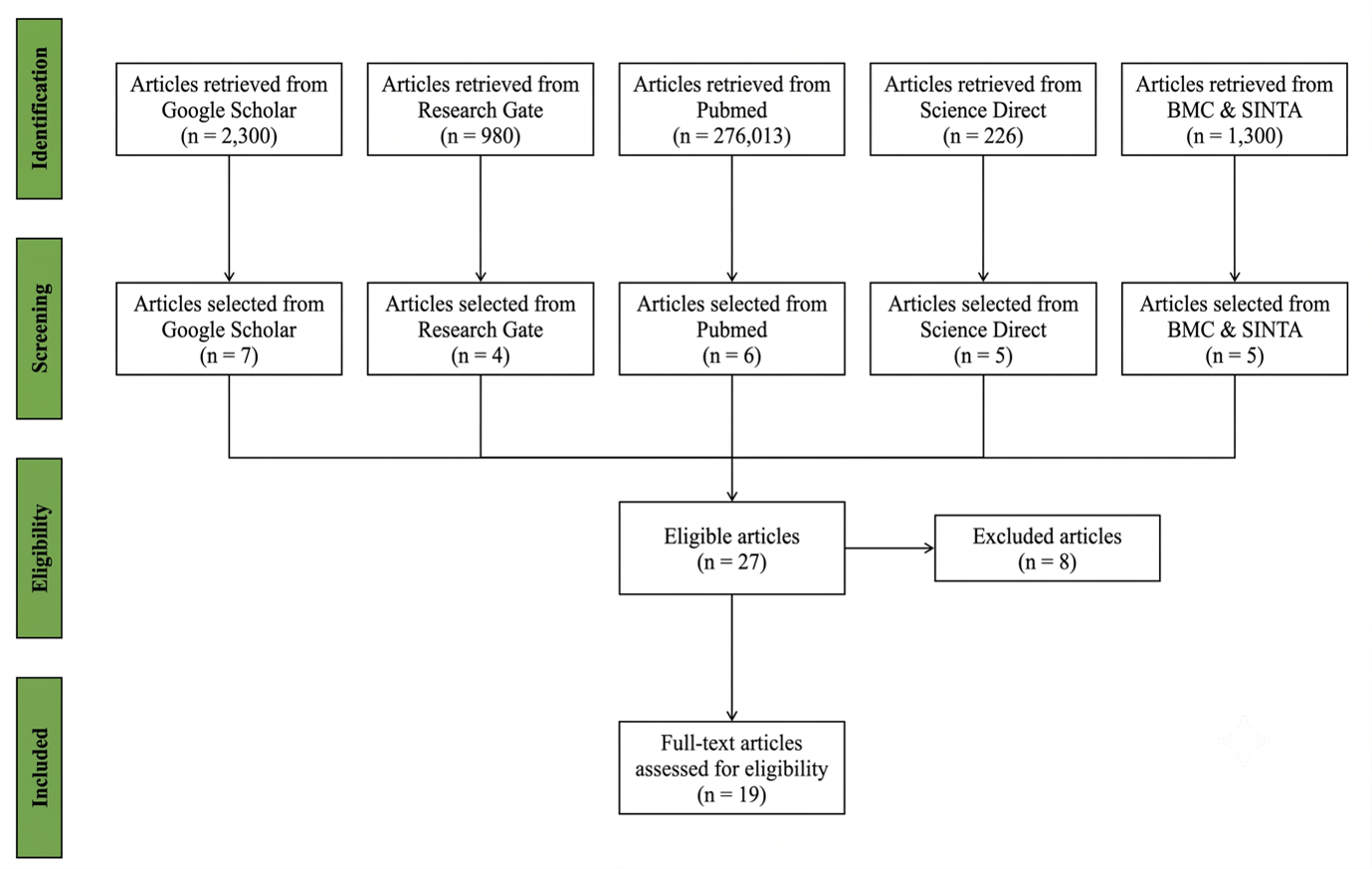
Acute Respiratory Infection (ARI) is among the most common health problems following earthquake disasters, resulting from overcrowded evacuation environments, poor ventilation, inadequate sanitation, and limited access to healthcare services. These conditions significantly increase the risk of pneumonia, upper respiratory infections, and exacerbation of chronic lung diseases. This literature review aimed to synthesize evidence on prevention, diagnosis, and medical interventions for ARI in earthquake disaster settings. A literature review was conducted using the PICO framework. A systematic search of PubMed, ScienceDirect, ProQuest, ResearchGate, and Google Scholar identified 16 eligible studies published between 2011 and 2025. Studies were selected based on predefined inclusion and exclusion criteria, and data were synthesized qualitatively. The literature consistently documented increased ARI cases following earthquakes, driven by shelter overcrowding, poor sanitation, dust exposure, psychological stress, and loss of routine medical access, particularly among children, the elderly, and patients with chronic obstructive pulmonary disease (COPD). Dominant pathogens included rhinovirus, respiratory syncytial virus (RSV), Streptococcus pneumoniae, and Haemophilus influenzae. Molecular diagnostics such as RT-qPCR improved early pathogen detection, while preventive measures including proper ventilation, mask use, hand hygiene, and strengthened surveillance systems effectively reduced ARI incidence. Managing ARI in earthquake settings requires a multidisciplinary approach encompassing improvement of evacuation environments, enhanced diagnostic capacity, prioritized triage for vulnerable groups, and comprehensive medical interventions to reduce morbidity and mortality among disaster-affected populations.
Downloads
References
World Health Organization. Pneumonia in children [Internet]. Geneva: WHO; 2022 [cited 2025 Jun 1]. Available from: https://www.who.int/news-room/fact-sheets/detail/pneumonia
Murarkar S, Gothankar J, Doke P, Dhumale G, Pore PD, Lalwani S, et al. Prevalence of the acute respiratory infections and associated factors in the rural areas and urban slum areas of western Maharashtra, India: A community-based cross-sectional study. Front Public Health. 2021;9:723807. doi:10.3389/fpubh.2021.723807.
Badan Penelitian dan Pengembangan Kesehatan. Riset Kesehatan Dasar (Riskesdas) 2007: Laporan Nasional 2007. Jakarta: Departemen Kesehatan RI; 2008.
Badan Penelitian dan Pengembangan Kesehatan. Riset Kesehatan Dasar (Riskesdas) 2013. Jakarta: Kementerian Kesehatan RI; 2013.
Badan Penelitian dan Pengembangan Kesehatan. Laporan Nasional Riskesdas 2018. Jakarta: Lembaga Penerbit Badan Penelitian dan Pengembangan Kesehatan; 2018.
Thomas M, Bomar PA. Upper respiratory tract infection. In: StatPearls [Internet]. Treasure Island (FL): StatPearls Publishing; 2024 [updated 2023 Jun 26; cited 2025 Jun 1]. Available from: https://www.ncbi.nlm.nih.gov/books/NBK532961/
Kombe AJK, Fotoohabadi L, Gerasimova Y, Nanduri R, Tamang PL, Kandala M, et al. The role of inflammation in the pathogenesis of viral respiratory infections. Microorganisms. 2024;12(12):2526. doi:10.3390/microorganisms12122526.
Sun Y, López CB. The innate immune response to RSV: Advances in our understanding of critical viral and host factors. Vaccine. 2016;35(3):481-488. doi:10.1016/j.vaccine.2016.09.030.
Kawano T, Tsugawa Y, Nishiyama K, Morita H, Yamamura O, Hasegawa K. Shelter crowding and increased incidence of acute respiratory infection in evacuees following the Great Eastern Japan Earthquake and tsunami. Epidemiol Infect. 2016;144(4):787-795. doi:10.1017/S0950268815001713.
Dogantekin E, Caliskanturk G, Aslan S, Dogantekin A. Epidemiology of respiratory infection pathogens using multiplex RT-qPCR in big earthquakes area in Turkey (2023). Clin Epidemiol Glob Health. 2024;29:101753. doi:10.1016/j.cegh.2024.101753.
Saatchi M, Khankeh HR, Shojafard J, Barzanji A, Ranjbar M, Nazari N, et al. Communicable diseases outbreaks after natural disasters: A systematic scoping review for incidence, risk factors and recommendations. Prog Disaster Sci. 2024;23:100334. doi:10.1016/j.pdisas.2024.100334.
Kobayashi S, Hanagama M, Yamanda S, Satoh H, Tokuda S, Kobayashi M, et al. The impact of a large-scale natural disaster on patients with chronic obstructive pulmonary disease: The aftermath of the 2011 Great East Japan Earthquake. Respir Investig. 2013;51(1):17-23. doi:10.1016/j.resinv.2012.10.004.
Sugimura M, Chimed-Ochir O, Yumiya Y, Taji A, Kishita E, Tsurugi Y, et al. Incidence of acute respiratory infections during disasters in the absence and presence of COVID-19 pandemic. Prehosp Disaster Med. 2022;37(1):142-144. doi:10.1017/S1049023X21001369.
Mavrouli M, Mavroulis S, Lekkas E, Tsakris A. Respiratory infections following earthquake-induced tsunamis: Transmission risk factors and lessons learned for disaster risk management. Int J Environ Res Public Health. 2021;18(9):4962. doi:10.3390/ijerph18094962.
Daffa MB, Khansa F, Ghifari MH, Zaskia SR, Jung Y. Global prevalence of natural disaster-induced acute respiratory infections: A systematic review and meta-analysis of 290,380 participants. Narra X. 2024;2(3):e181. doi:10.52225/narrax.v2i3.181.
Güngör Ö, Erçen Diken Ö, Berik Safcı S, Avcı A, Aslan Aİ. Respiratory diseases and mortality in non-traumatic patients exposed to the 2023 Türkiye earthquake disasters: A retrospective observational study. BMJ Open. 2025;15(1):e092177. doi:10.1136/bmjopen-2024-092177.
Avcu G. Infections after the earthquake disaster. J Pediatr Res. 2023;10(4):235-237. doi:10.4274/jpr.galenos.2023.99997.
Kouadio IK, Aljunid S, Kamigaki T, Hammad K, Oshitani H. Infectious diseases following natural disasters: Prevention and control measures. Expert Rev Anti Infect Ther. 2012;10(1):95-104. doi:10.1586/eri.11.155.
Kaya EK, Halacli B, Guven G, Yildirim M, Seven AE, Gemcioglu E, et al. Infections among adults hospitalized in intensive care after the 2023 earthquake in the southeastern part of Türkiye: A multi-center observational study. BMC Infect Dis. 2025;25:35. doi:10.1186/s12879-024-10432-8.
Kaya SB. The disastrous earthquake in Turkey and its effects on respiratory disease. Bratisl Med J. 2025;126:1032-1041. doi:10.4149/BLL_2025_102.
Yavuz MY, Ayık Türk M, Oral B, Coşkun Beyan A. Earthquake and respiratory pollutants. Eurasian J Pulmonol. 2024;26:1-9. doi:10.14744/ejp.2024.78901.
Akbarbegloo M, Heydari A, Sanaeefar M, Fallah-Aliabadi S. Exploring the health challenges of affected people in the 2023 Khoy earthquake: A content analysis. BMC Emerg Med. 2024;24:204. doi:10.1186/s12873-024-01126-3.
Robinson B, Alatas MF, Robertson A, Steer H. Natural disasters and the lung. Respirology. 2011;16(3):386-395. doi:10.1111/j.1440-1843.2011.01923.x.
Isnaini, Yani FF, Jurnalis YD, Mariko R. The incidence and characteristics of acute respiratory infection (ARI) after the earthquake in West Pasaman and Pasaman Districts, West Sumatra Province in 2022. E3S Web Conf. 2024;604:16005. doi:10.1051/e3sconf/202460416005.
Downloads
Published
How to Cite
Issue
Section
License
Copyright (c) 2026 Journal of Diverse Medical Research : Medicosphere

This work is licensed under a Creative Commons Attribution 4.0 International License.
CC Attribution 4.0








 This journal applies the Creative Commons Attribution 4.0 International License (CC BY 4.0), which permits unrestricted use, distribution, and reproduction in any medium, provided the original author and source are properly credited.