
Pathophysiology of Crush Syndrome and Its Prehospital Management, with Preventive Strategies for Earthquake Victims
A Literature Review
DOI:
https://doi.org/10.33005/jdiversemedres.v3i8.368Keywords:
Crush Syndrome, Earthquake, Fluid resuscitation, Prehospital care, RhabdomyolysisAbstract
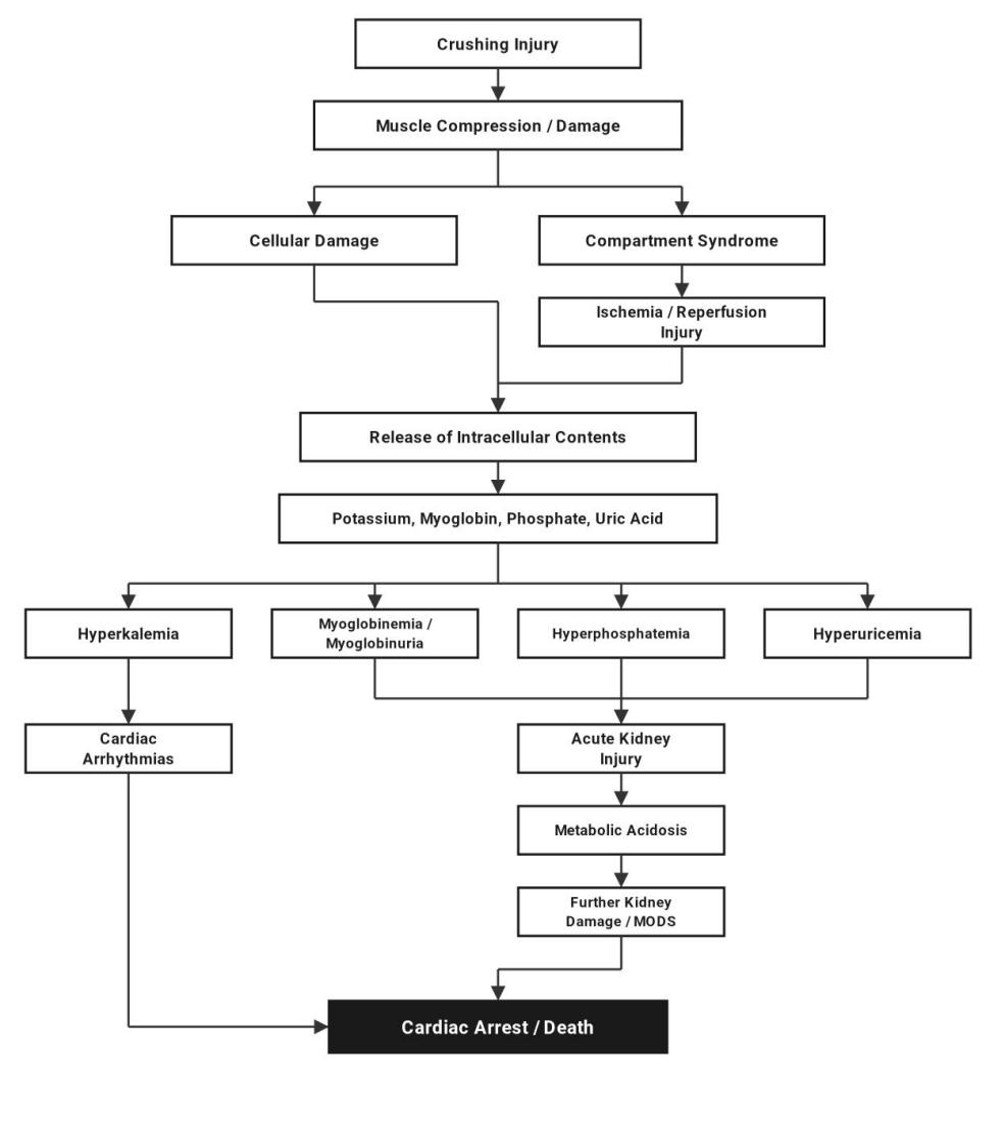
Earthquakes are major public health disasters that frequently cause building collapses and prolonged entrapment, resulting in crush injuries that may progress to crush syndrome (CS), a life-threatening systemic complication of traumatic muscle damage. This literature review aims to summarize the pathophysiology of CS and evaluate current prehospital management and preventive strategies to improve survival among earthquake victims. A comprehensive search of PubMed, ScienceDirect, and ResearchGate was conducted using the PICO framework and Boolean operators. Open-access English articles published between 2017 and 2026 were screened, yielding 17 eligible studies from 2,530 initial records for qualitative synthesis. The findings indicate that CS develops through ischemia during compression followed by reperfusion injury after extrication, leading to rhabdomyolysis, hyperkalemia, and acute kidney injury. Effective prehospital management includes rapid triage and early administration of potassium-free isotonic saline before extrication to reduce systemic complications. Adjunctive measures, including urine alkalinization with sodium bicarbonate, calcium gluconate for myocardial stabilization, and cooling therapy, may further improve outcomes. Early recognition and aggressive pre-extrication fluid resuscitation remain the cornerstone of CS management, minimizing reperfusion-related complications, preventing acute kidney injury, and improving survival in earthquake mass-casualty settings.
Downloads
References
Yeşiloğlu Ö, Doğan S, Avci A. Approach to Earthquake Victims at Emergency Services: A Review and Analysis of Current Practices. Cam and Sakura Medical Journal. 2023 Dec 29;3(Suppl 1):4–13. doi:10.4274/csmedj.galenos.2023.2023-9-8
Abu-Zidan FM, Idris K, Cevik AA. Prehospital management of earthquake crush injuries: A collective review. Turkish Journal of Emergency Medicine. Wolters Kluwer Medknow Publications; 2023. p. 199–210. doi:10.4103/tjem.tjem_201_23
Nola IA, Dvorski M, Žižak M, Kuliš T. CRUSH SYNDROME IN EARTHQUAKES – STAY AND PLAY OR LOAD AND GO? Acta Clin Croat. 2023;62:158–65. doi:10.20471/acc.2023.62.s2.24 PubMed PMID: 38966034.
Thanapaul RJRS, Govindarajulu MY, Pundkar CY, Arun P. Pathophysiology-guided biomarkers and therapeutics for precision trauma medicine in polytrauma with musculoskeletal injuries. Military Medical Research. KeAi Communications Co.; 2026. doi:10.1016/j.mmr.2026.100014
Usuda D, Shimozawa S, Takami H, Kako Y, Sakamoto T, Shimazaki J, et al. Crush syndrome: a review for prehospital providers and emergency clinicians. Journal of Translational Medicine. BioMed Central Ltd; 2023. doi:10.1186/s12967-023-04416-9 PubMed PMID: 37653520.
Abu-Zidan FM, Idris K, Cevik AA. Management of earthquake-related acute renal injury. World J Nephrol. 2025 Sep 25;14(3). doi:10.5527/wjn.v14.i3.107201
Khan S, Neradi D, Unnava N, Jain M, Tripathy SK. Pathophysiology and management of crush syndrome: A narrative review. World J Orthop. 2025;16(4):1–12. doi:10.5312/wjo.v16.i4.104489
Cao R, Huang X, Qi W, Li B, Lu Z, Zhang H, et al. Crush syndrome: a comprehensive review of experimental models and emerging therapeutic strategies. Discover Medicine. 2025 May 26;2(1). doi:10.1007/s44337-025-00343-4
Seah Z, Wulandari J. Importance of early prehospital intervention in crush injury and compartment syndrome: a case report. Journal of Medical Case Reports . 2025 Dec 1;19(1). doi:10.1186/s13256-025-05598-0 PubMed PMID: 41163206.
Akrivos VS, Koutalos A, Stefanou N, Koskiniotis A, Arnaoutoglou C. Crush injury and crush syndrome: a comprehensive review. EFORT Open Rev. 2025;10(6):424–30. doi:10.1530/EOR-2025-0055
Orlyk V. Emergency Medical Care for Victims with Crush Syndrome at the Pre-Hospital Stage. Lviv Clinical Bulletin. 2025 Mar 26;(1 (49)):50–7. doi:10.25040/lkv2025.01.050
Hamlah A, Tarabishy AA, Al-Madhagi H. Mini Review of Biochemical Basis, Diagnosis and Management of Crush Syndrome. Acta Med Litu. 2023 Jul 31;30(2):133–8. doi:10.15388/Amed.2023.30.2.5
Daniş R, Öztürk S, Koçyiğit İ, Kılıç J, Civan M, Şahutoğlu T, et al. Pre-earthquake kidney function is a predictor of outcomes in earthquake-related crush syndrome. BMC Nephrol. 2025 Dec 1;26(1). doi:10.1186/s12882-025-04183-3 PubMed PMID: 40484930.
Abu-Zidan FM, Jawas A, Idris K, Cevik AA. Surgical and critical care management of earthquake musculoskeletal injuries and crush syndrome: A collective review. Turkish Journal of Emergency Medicine. Wolters Kluwer Medknow Publications; 2024. p. 67–79. doi:10.4103/tjem.tjem_11_24
Nepali R, Sigdel MR, Shah DS. Rhabdomyolysis in Earthquake Victims in Nepal. Kidney International Reports. Elsevier Inc; 2017. p. 127–9. doi:10.1016/j.ekir.2016.11.009
Wood F, Cowburn P, Smith J, Weekes L, Godfrey T. Consensus Statement on the Pre-Hospital Management of Crush Injury. 2025 May. doi:https://fphc.rcsed.ac.uk/media/3912/crush-consensus-fphc_fw.pdf.
Yang BF, Li D, Liu CL, Luo Y, Shi J, Guo XQ, et al. Advances in rhabdomyolysis: A review of pathogenesis, diagnosis, and treatment. Chinese Journal of Traumatology - English Edition. Elsevier B.V.; 2025. doi:10.1016/j.cjtee.2024.10.005
Downloads
Published
How to Cite
Issue
Section
License
Copyright (c) 2026 Journal of Diverse Medical Research : Medicosphere

This work is licensed under a Creative Commons Attribution 4.0 International License.
CC Attribution 4.0








 This journal applies the Creative Commons Attribution 4.0 International License (CC BY 4.0), which permits unrestricted use, distribution, and reproduction in any medium, provided the original author and source are properly credited.