
Integration of Telemedicine and Digital Environmental Monitoring for Early Detection of Environmentally Related Diseases in Remote Areas
A Literature Review
DOI:
https://doi.org/10.33005/jdiversemedres.v3i4.344Keywords:
digital environmental monitoring, early detection, environment-based diseases, health IoT, remote areas, telemedicineAbstract
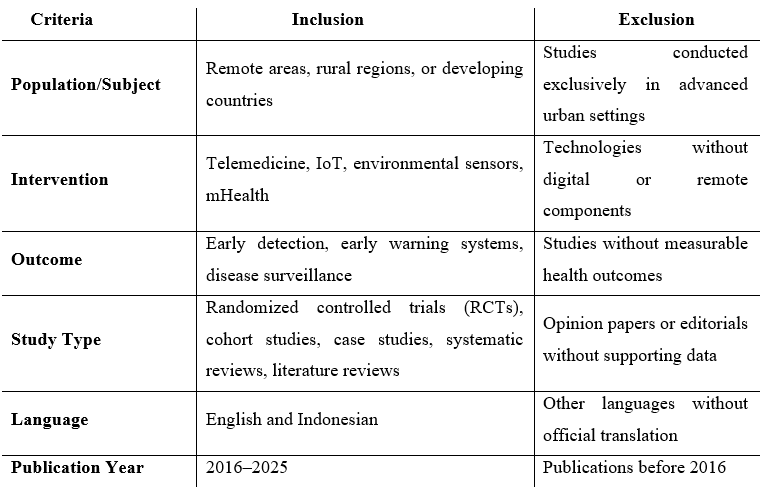
Environment-based diseases such as Acute Respiratory Infections (ARI), diarrhea, malaria, and leptospirosis remain major causes of morbidity in remote areas of Indonesia. This condition is exacerbated by limited access to healthcare facilities and the lack of real-time environmental monitoring systems that support early disease detection. This study aims to design and analyze an integrated model of telemedicine and Internet of Things (IoT)-based digital environmental monitoring systems to improve the early detection of environment-related diseases. The study employed a systematic literature review using the PRISMA protocol on 15–20 references from journals indexed in Scopus, PubMed, and SINTA published within the last 5–10 years, complemented by implementation case studies in remote regions of Indonesia. The analyzed parameters included PM2.5 levels, water quality indicators (E. coli, turbidity, and pH), temperature, relative humidity, vector presence, and telemedicine clinical responses. The literature synthesis indicates that the integration of telemedicine with digital environmental monitoring has the potential to improve the early detection of environment-based diseases compared to the use of each system separately. The integrated model, which applies automatic threshold mechanisms such as PM2.5 > 100 µg/m³, E. coli > 100 CFU/100 mL, and humidity > 80%, enables the system to provide earlier and more proactive alerts to healthcare workers through telemedicine applications. Furthermore, this integration is expected to reduce diagnostic delays, improve healthcare service efficiency, and lower referral costs in remote areas.
Downloads
References
Kementerian Kesehatan Republik Indonesia. Profil kesehatan Indonesia 2022. Jakarta: Kementerian Kesehatan Republik Indonesia; 2023.
World Health Organization. Telemedicine: opportunities and developments in member states. Geneva: World Health Organization; 2010.
Saputra YA, Armawan LVA, Lisa M, Muharramah DH, Pratiwi LD. The Role of Hydrometeorological Factors in Leptospirosis Transmission in Central Java, Indonesia. J Prev Med Public Health. 2025;58(6):553-562. https://doi.org/10.3961/jpmph.25.114
Alfiyyah A, Ayuningtyas D, Rahmanto A. Telemedicine and electronic health record implementation in rural area. Indones Health Policy Adm. 2022;7(2). Available from: https://scholarhub.ui.ac.id/ihpa/vol7/iss2/2/
Saputra R. Telemedicine: Solutions and Challenges for Health Workers in Rural Indonesia in the Response to the COVID -19 Pandemic. Disaster Medicine and Public Health Preparedness. 2024;18:e203. doi:10.1017/dmp.2024.122
Dimitrievski A, Filiposka S, Melero FJ, Zdravevski E, Lameski P, Pires IM, et al. Rural healthcare IoT architecture based on low-energy LoRa. Int J Environ Res Public Health. 2021;18(14):7660. doi:10.3390/ijerph18147660
Sahu KS, Majowicz SE, Dubin JA, Morita PP. NextGen public health surveillance and the Internet of Things (IoT). Front Public Health. 2021;9:756675. doi:10.3389/fpubh.2021.756675
Islam MR, Kabir MM, Mridha MF, Alfarhood S, Safran M, Che D. Deep learning-based IoT system for remote monitoring and early detection of health issues in real-time. Sensors (Basel). 2023;23(11):5204. doi:10.3390/s23115204
Sujarwoto S, Augia T, Dahlan H, Sahputri RAM, Holipah H, Maharani A. COVID-19 Mobile Health Apps: An Overview of Mobile Applications in Indonesia. Front Public Health. 2022 May 4;10:879695. doi: 10.3389/fpubh.2022.879695. PMID: 35602145; PMCID: PMC9114306.
World Health Organization. World malaria report 2023. Geneva: World Health Organization; 2023. Available from: https://www.who.int/teams/global-malaria-programme/reports/world-malaria-report-2023
Topol EJ. High-performance medicine: the convergence of human and artificial intelligence. Nat Med. 2019;25(1):44-56. doi:10.1038/s41591-018-0300-7
Felici-Castell S, Segura-Garcia J, Perez-Solano JJ, Fayos-Jordan R, Soriano-Asensi A, Alcaraz-Calero JM. AI-IoT low-cost pollution-monitoring sensor network to assist citizens with respiratory problems. Sensors (Basel). 2023;23(23):9585. doi:10.3390/s23239585
Al Aufa B, Nurfikri A, Mardiati W, Sancoko S, Yuliyanto H, Nurmansyah MI, et al. Feasibility, acceptance and factors related to the implementation of telemedicine in rural areas: a scoping review protocol. SAGE Open Med. 2023;11. doi:10.1177/20552076231171236
Sutiningsih D, Sari DP, Permatasari CD, Azzahra NA, Rodriguez-Morales AJ, Yuliawati S, Maharani NE. Geospatial Analysis of Abiotic and Biotic Conditions Associated with Leptospirosis in the Klaten Regency, Central Java, Indonesia. Tropical Medicine and Infectious Disease. 2024; 9(10):225. https://doi.org/10.3390/tropicalmed9100225
Singh Y, Walingo T. Smart water quality monitoring with IoT wireless sensor networks. Sensors (Basel). 2024;24(9):2871. doi:10.3390/s24092871
Kurniawan I. Teknologi Informasi Bidang Kedokteran Jilid 1. Lamongan: Ghani Press Group; 2026. 149 p.
Wiryasaputra R, Huang CY, Lin YJ, Yang CT. An IoT real-time potable water quality monitoring and prediction model based on cloud computing architecture. Sensors (Basel). 2024;24(4):1180. doi:10.3390/s24041180
McMahon A, Mihretie A, Ahmed AA, Lake M, Awoke W, Wimberly MC. Remote sensing of environmental risk factors for malaria in different geographic contexts. Int J Health Geogr. 2021;20(1):28. doi:10.1186/s12942-021-00282-0
Sutiningsih D, Sari DP, Permatasari CD, Azzahra NA, Rodriguez-Morales AJ, Yuliawati S, Maharani NE. Geospatial Analysis of Abiotic and Biotic Conditions Associated with Leptospirosis in the Klaten Regency, Central Java, Indonesia. Tropical Medicine and Infectious Disease. 2024; 9(10):225. https://doi.org/10.3390/tropicalmed9100225
World Health Organization. WHO global air quality guidelines: particulate matter (PM2.5 and PM10), ozone, nitrogen dioxide, sulfur dioxide and carbon monoxide. Geneva: World Health Organization; 2021. Available from: https://apps.who.int/iris/handle/10665/345329
Wimberly MC, de Beurs KM, Loboda TV, Pan WK. Satellite observations and malaria: new opportunities for research and applications. Trends Parasitol. 2021;37(6):525-537. doi:10.1016/j.pt.2021.03.003
Downloads
Published
How to Cite
Issue
Section
License
Copyright (c) 2026 Journal of Diverse Medical Research : Medicosphere

This work is licensed under a Creative Commons Attribution 4.0 International License.
CC Attribution 4.0





 This journal applies the Creative Commons Attribution 4.0 International License (CC BY 4.0), which permits unrestricted use, distribution, and reproduction in any medium, provided the original author and source are properly credited.