Education on Ari Risk Mitigation Caused by Environmental Mold and Waste Management in The Community of Tembok Dukuh Sub-District, Bubutan District, Surabaya
Research Article
DOI:
https://doi.org/10.33005/jdiversemedres.v3i5.342Keywords:
ARI, environmental mold, waste management, health education, clean and healthy living behaviorAbstract
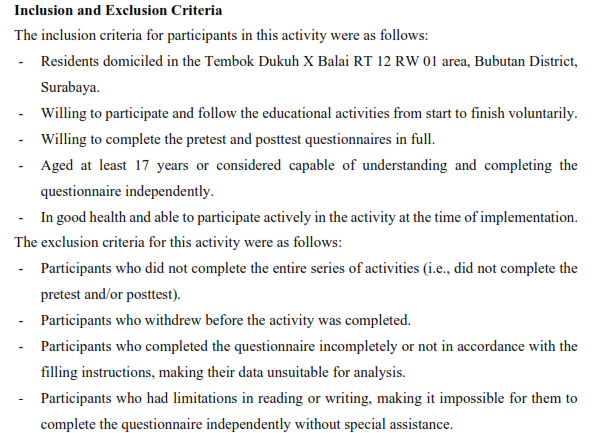
Background: Acute Respiratory Infection (ARI) is the disease with the highest number of cases in Indonesia, with one of the often-overlooked environmental risk factors being mold growth caused by indoor humidity and poor waste management. Objective: This community service activity aimed to improve public knowledge and awareness regarding the relationship between environmental mold, waste management, and the risk of ARI, as well as to encourage the implementation of clean and healthy living behavior (PHBS). Methods: The activity was conducted on Saturday, 23 April 2026, from 07:45 to 10:00 WIB at Tembok Dukuh X Balai RT 12 RW 01, Tembok Dukuh Sub-district, Bubutan District, Surabaya, targeting 25 residents. The implementation method consisted of a pretest, education and outreach, interactive discussion, a waste management demonstration, and a posttest as the evaluation instrument using an 8-item multiple-choice questionnaire. Results: The results showed an increase in the participants’ average knowledge score from 6.88 (median 7; range 4–8) at pretest to 7.69 (median 8; range 7–8) at posttest, accompanied by a narrowing score range indicating more even understanding among participants. Conclusion: This activity proved effective in improving community knowledge regarding ARI risk mitigation due to environmental mold and waste management, and is expected to be applied sustainably in daily life.
Downloads
References
Kementerian Kesehatan Republik Indonesia. (2025). Profil Kesehatan Indonesia Tahun 2025. Jakarta: Kemenkes RI. Tersedia pada: https://www.kemkes.go.id
Maaranen, J., Hugg, T. T., Paciência, I., Jaakkola, M. S., Jaakkola, J. J. K., & Rantala, A. K. (2025). Home dampness and molds and occurrence of respiratory tract infections in the first 27 years of life: The Espoo Cohort Study. American Journal of Epidemiology, 194(12), 3492–3500. https://doi.org/10.1093/aje/kwaf200
de Titto, E., & Savino, A. (2024). Human health impact of municipal solid waste mismanagement: A review. Advances in Environmental and Engineering Research, 5(2), 014. https://doi.org/10.21926/aeer.2402014
Eshete, H., Desalegn, A., & Tigu, F. (2023). Knowledge, attitudes and practices on household solid waste management and associated factors in Gelemso town, Ethiopia. PLOS ONE, 18(2), e0278181. https://doi.org/10.1371/journal.pone.0278181
Mulyadi, Erlani, Rasman, & Farida. (2024). Peningkatan pengetahuan masyarakat dalam upaya pencegahan penyakit Infeksi Saluran Pernapasan (ISPA). Comfort Journal, 3(2), 10–13.
Gach, M. W., Lazarus, G., Simadibrata, D. M., Sinto, R., Saharman, Y. R., Limato, R., Nelwan, E. J., van Doorn, H. R., Karuniawati, A., & Hamers, R. L. (2024). Antimicrobial resistance among common bacterial pathogens in Indonesia: A systematic review. The Lancet Regional Health – Southeast Asia, 26, 100414. https://doi.org/10.1016/j.lansea.2024.100414
World Health Organization. (2025). Disease outbreak news: Acute respiratory infections – global update. Geneva: WHO. Tersedia pada: https://www.who.int/emergencies/disease-outbreak-news/item/2025-DON550
Jurnal Keperawatan Tropis Papua. (2024). Efektivitas pendidikan kesehatan terhadap pengetahuan mahasiswa keperawatan Wamena tentang HIV/AIDS: Penelitian dengan desain pretest-posttest pada satu kelompok. Jurnal Keperawatan Tropis Papua, 7(2). Tersedia pada: https://jktp.jurnalpoltekkesjayapura.com
Azahar, S. N. S., Sopian, N. A., Abdull, N., & Hussin, N. H. M. (2024). Determination of Mold Invasion and Occupants Respiratory Health in University Laboratories. Aerosol and Air Quality Research, 24(11), 1-12. https://doi.org/10.4209/aaqr.240119
Suhartina, Siregar, S.D., & Zaluchu, S. O. (2025). Analysis Of Factors Related To The Incidence Of Acute Respiratory InfectionIn Toddlers In The Area Of Tuntungan Community Health Center, Deli Serdang Regency 2024. International Journal of Health and Pharmaceutical, 5(2), 216-223. https://doi.org/10.51601/ijhp.v5i1.388
Sudirman, Taslim, Marwah, Rudini, M., & Armadi. (2024). The Relationship Between Housing Sanitation Factors and the Incidence of Acute Respiratory Infections (ARI) in the Batulappa Health Center Work Area. Journal of Community Health Privision, 4(3), 158-164. https://doi.org/10.55885/jchp.v4i3.425
Istiqomah, Widiarini, R., & Ramadanintyas, K. N. (2022). Relationship of Ventilation And Waste Management With Acute Respiratory Infection Event in Banjarsari Wetan Village in 2021. Jurnal Kesehatan Mahardika, 9(2), 23-28. DOI:10.54867/jkm.v9i2.120
Tuasikal, Y., & Fajar, H. (2025). Health Education as a Strategic Approach to Prevent Acute Respiratory Infection (ARI). Journal of Evidence-Based Community Health, 2(2), 9-14. https://doi.org/10.1234/6862xn53
Rukmasari, E. A., Herman, R. Y., & Solehati, T. (2025). The Relationship Between Knowledge and Behavior in Preventing Acute Respiratory Infection (ARI) Among Students of SDN 017 Sekejati, Bandung City. International Journal of Science and Society, (7)3, 104-111. https://doi.org/10.54783/ijsoc.v7i3.1482
Gifari, R.M., & Zubir, A. A. A. (2024). The Role of Environmental Factors on Disease and Transmission of Infectious Diseases. Environmental and Toxicology Management, 4(3), 11-16. DOI:110.33086/etm.v4i3.7099
Caillaud, D., & Leynaert, B. (2018). Indoor Mould Exposure, Asthma and Rhinitis: Findings from Systematic Reviews and Recent Longitudinal Studies. European Respiratory Review, 27(148), 1-18. https://doi.org/10.1183/16000617.0137-2017
Downloads
Published
How to Cite
Issue
Section
License
Copyright (c) 2026 Journal of Diverse Medical Research : Medicosphere

This work is licensed under a Creative Commons Attribution 4.0 International License.
CC Attribution 4.0





 This journal applies the Creative Commons Attribution 4.0 International License (CC BY 4.0), which permits unrestricted use, distribution, and reproduction in any medium, provided the original author and source are properly credited.