
Diagnostic Challenges in a Patient with Acquired Hemophilia A: a Case Report from Rural Hospital
A Case Report
DOI:
https://doi.org/10.33005/jdiversemedres.v3i4.328Keywords:
Acquired Hemophilia A, factor VIII, prolonged APTTAbstract
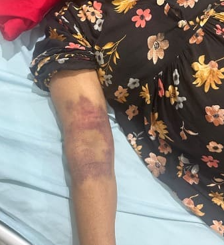
Acquired Hemophilia A (AHA) is a rare autoimmune bleeding disorder caused by autoantibodies against factor VIII, typically affecting older adults without prior bleeding history. Its nonspecific presentation often leads to underdiagnosis, particularly in resource-limited settings. We report a 62-year-old woman presenting with spontaneous extensive bruising without trauma or anticoagulant use. Examination revealed multiple hematomas. Laboratory findings showed anemia (Hb 9.1 g/dL), normal platelet count and prothrombin time, and isolated prolonged APTT that failed to correct on mixing study, indicating an inhibitor. Factor VIII activity was markedly reduced (5%). Due to limited facilities, inhibitor titration could not be performed. A diagnosis of AHA was established, and the patient was treated with corticosteroids and azathioprine, resulting in clinical improvement. Diagnosis of AHA relies on recognizing isolated prolonged APTT uncorrected by mixing studies. In rural hospitals, limited access to specialized assays poses challenges, making early clinical suspicion essential. Management includes bleeding control and inhibitor eradication using immunosuppressive therapy. AHA should be suspected in patients with unexplained bleeding and isolated prolonged APTT. This report highlights a pragmatic diagnostic approach to AHA in resource-limited settings where confirmatory assays are unavailable.
Downloads
References
Tiede A, Collins P, Knoebl P, Teitel J, Kessler C, Shima M, et al. International recommendations on the diagnosis and treatment of acquired hemophilia A. Haematologica. 2020;105(7):1791–801.
Kruse-Jarres R, Kempton CL, Baudo F, Collins P, Knoebl P, Leissinger CA, et al. Acquired hemophilia A: Updated review of evidence and treatment guidance. Am J Hematol. 2017;92(7):695–705.
Franchini M, Gandini G, Di Paolantonio T, Mariani G. Acquired hemophilia A: a concise review. Am J Hematol. 2005;80(1):55-63.
Green D, Lechner K. A survey of 215 non-hemophilic patients with inhibitors to factor VIII. Thromb Haemost. 1981;45(3):200-203.
Ma AD, Carrizosa D. Acquired factor VIII inhibitors: pathophysiology and treatment. Hematology Am Soc Hematol Educ Program. 2006;2006(1):432-437.
White GC 2nd, Rosendaal F, Aledort LM, et al. Definitions in hemophilia. Thromb Haemost. 2001;85(3):560.
Devreese KMJ, de Groot PG, de Laat B, et al. Guidance from the Scientific and Standardization Committee on lupus anticoagulant/antiphospholipid antibodies. J Thromb Haemost. 2020;18(11):2828-2839.
Olson JD, Arkin CF, Brandt JT, et al. College of American Pathologists Conference XXXI on laboratory monitoring of anticoagulant therapy. Arch Pathol Lab Med. 1998;122(9):787-793.
Boggio LN, Green D. Acquired hemophilia. Rev Clin Exp Hematol. 2001;5(4):389-404.
A: a retrospective study. Blood Coagul Fibrinolysis. 2021;32(6):415-421.
Napolitano M, Siragusa S, Mancuso S, et al. Acquired hemophilia in cancer patients: a systematic review. Semin Thromb Hemost. 2019;45(7):728-738.
Collins P, Baudo F, Knoebl P, Levesque H, Nemes L, Pellegrini F, et al. Immunosuppression for acquired hemophilia A: results from the EACH2 registry. Blood. 2012;120(1):47–55.
Downloads
Published
How to Cite
Issue
Section
License
Copyright (c) 2026 Journal of Diverse Medical Research : Medicosphere

This work is licensed under a Creative Commons Attribution 4.0 International License.
CC Attribution 4.0





 This journal applies the Creative Commons Attribution 4.0 International License (CC BY 4.0), which permits unrestricted use, distribution, and reproduction in any medium, provided the original author and source are properly credited.