
The Relationship Between Temperature, Greenhouse Gas Emissions, and Malaria Cases in Indonesia
Original Article
DOI:
https://doi.org/10.33005/jdiversemedres.v3i3.320Keywords:
Greenhouse Gas Emissions, Global Warming, Malaria, TemperatureAbstract
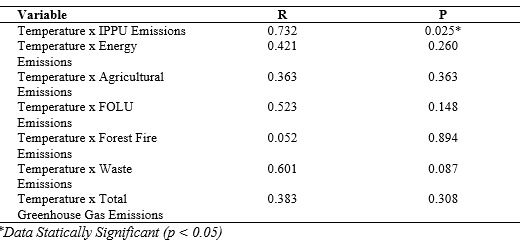
Malaria is still a public health problem in Indonesia and had the potential to be affected by climate change due to greenhouse gas emissions. This study aimed to analyze the correlations among greenhouse gas emissions across sectors, temperature, humidity, and malaria incidence in Indonesia. The study used an ecological design with a quantitative observational approach based on national aggregate data for the period 2000–2019. Greenhouse gas emission data were obtained from national inventory reports, temperature and humidity data from BMKG, and malaria data from BPS. Statistical analysis was carried out using the Spearman rank correlation test. The results showed that only the emissions of the Industrial Processes and Product Use (IPPU) sector had a strong and significant positive correlation with temperature (p = 0.025). In contrast, the other emission sectors were not significant. In addition, temperature and humidity showed a strong, significant negative correlation with malaria incidence (p = 0.007 and p = 0.005). These findings confirm that the relationship between climate and malaria is complex and non-linear, and is influenced by non-climatic factors such as strengthening of health systems and vector control.
Downloads
References
World Health Organization. Malaria [Internet]. 2024. Available from: https://www.who.int/news-room/fact-sheets/detail/malaria
WHO. Malaria [Internet]. 2022 [cited 2022 Nov 5]. Available from: https://www.who.int/news-room/fact-sheets/detail/malaria
Kementerian Kesehatan RI. Tren Kasus Malaria Menurun [Internet]. 2021 [cited 2022 Nov 5]. Available from: https://sehatnegeriku.kemkes.go.id/baca/rilis-media/20210423/3337549/tren-kasus-malaria-menurun/
Kementrian Kesehatan Indonesia. Kasus Malaria di Indonesia [Internet]. Available from: https://malaria.kemkes.go.id/case
Wang Z, Liu Y, Li Y, Wang R, Tian H, Wang G, et al. The relationship between rising temperatures and malaria incidence in Hainan, China, from 1984 to 2010: a longitudinal cohort study. Articles Lancet Planet Health [Internet]. 2022. Available from: www.thelancet.com/
Eikenberry SE, Gumel AB. Mathematical modeling of climate change and malaria transmission dynamics: a historical review. Journal of Mathematical Biology. Springer Verlag; 2018. p. 857–933. doi:10.1007/s00285-018-1229-7 PubMed PMID: 29691632.
United Nations. What Is Climate Change? [Internet]. 2020 [cited 2022 Nov 5]. Available from: https://www.un.org/en/climatechange/what-is-climate-change
World Bank Group. INDONESIA CLIMATE RISK COUNTRY PROFILE [Internet]. Manila, Philipins; 2021. Available from: www.worldbank.org
Forest Digest. What is FOLU Net Sink [Internet]. 2021. Available from: https://www.forestdigest.com/detail/1411/folu-net-sink
Kementerian PPN. ENERGI [Internet]. 2022. Available from: https://lcdi-indonesia.id/grk-energi
KLHK. Sektor IPPU [Internet]. Available from: https://karbon.ditjenppi.org/faq-iklim-dan-karbon/ippu
Hu L, Hu X, Li B, Guo L, Chen D, Yang Y, et al. Carbon dioxide emissions from industrial processes and product use are a non-ignorable factor in China’ s mitigation. Commun Earth Environ. 2024;5(1). doi:10.1038/s43247-024-01951-1
Bashmakov IA, Nilsson LJ, Acquaye A, Bataille C, Cullen M, Fischedick M, et al. Industry. Western Europe: geographical perspectives. Second edition. New York; 2022. doi:10.4324/9781315721132-14
Wang F, Sun C, Chen S, Zhou Q, Wang C. Energy-Related Carbon Emissions in Mega City in Developing Country: Patterns and Determinants Revealed by Hong Kong. Sustain. 2025;17(15):1–25. doi:10.3390/su17156854
Xiang J, Hansen A, Liu Q, Tong MX, Liu X, Sun Y, et al. Association between malaria incidence and meteorological factors: A multi-location study in China, 2005-2012. Epidemiol Infect. 2018;146(1):89–99. doi:10.1017/S0950268817002254 PubMed PMID: 29248024.
Velders GJM, Daniel JS, Montzka SA, Vimont I, Rigby M, Krummel PB, et al. Projections of hydrofluorocarbon (HFC) emissions and the resulting global warming based on recent trends in observed abundances and current policies. Atmos Chem Phys. 2022;22(9):6087–101. doi:10.5194/acp-22-6087-2022
Murugan Y. Association between temperature and malaria ( 1959-2019 ): a systematic review and meta- analysis. 2025.
Yamba EI, Badu K, Kyeimiah TA, Abrokwah NO, Asare S, Adjei MJ, et al. Warming temperatures reduce lifespan and vectorial capacity of Anopheles mosquitoes in Ghana. Infect Dis Model. 2026;11(2):652–70. doi:10.1016/j.idm.2025.12.011
Kripa PK, Thanzeen PS, Jaganathasamy N, Ravishankaran S. Impact of climate change on temperature variations and extrinsic incubation period of malaria parasites in Chennai , India : implications for its disease transmission potential. Parasit Vectors. 2024;1–12. doi:10.1186/s13071-024-06165-0
Rahmani AA, Susanna D, Febrian T. The relationship between climate change and malaria in South-East Asia: A systematic review of the evidence. F1000Research. 2022;11:1555. doi:10.12688/f1000research.125294.2 PubMed PMID: 37867624.
Sitohang V, Sariwati E, Fajariyani SB, Hwang D, Kurnia B, Hapsari RK, et al. Malaria elimination in Indonesia: halfway there. Lancet Glob Heal. 2018;6(6):e604–6. doi:10.1016/S2214-109X(18)30198-0 PubMed PMID: 29703663.
Setianingsih E, Sulistyaningrum E. Public Health in Practice The impact of the malaria centre program on malaria incidence in Papua Province. Public Heal Pract. 2025;9(May):100625. doi:10.1016/j.puhip.2025.100625
Downloads
Published
How to Cite
Issue
Section
License
Copyright (c) 2026 Journal of Diverse Medical Research : Medicosphere

This work is licensed under a Creative Commons Attribution-NonCommercial-ShareAlike 4.0 International License.
CC Attribution 4.0





 This journal applies the Creative Commons Attribution 4.0 International License (CC BY 4.0), which permits unrestricted use, distribution, and reproduction in any medium, provided the original author and source are properly credited.