
The Role of Telemedicine in Managing Patients During the COVID-19 Pandemic: A Systematic Review of Clinical Applications and Challenges
A Literature Review
DOI:
https://doi.org/10.33005/jdiversemedres.v3i2.226Keywords:
Telemedicine, COVID-19, Hybrid Healthcare, Digital Health, Chronic Disease ManagementAbstract
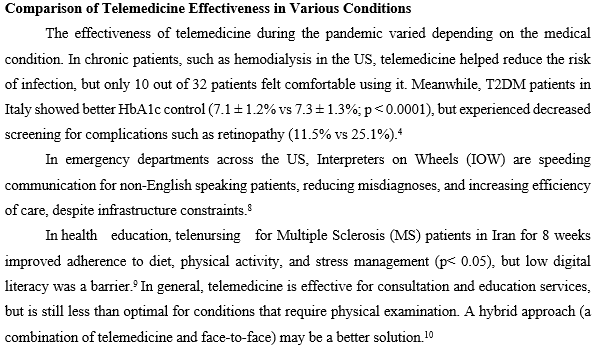
The COVID-19 pandemic has accelerated the adoption of telemedicine, improving access to remote healthcare, chronic disease management, and health education. However, its effectiveness varies, particularly for conditions requiring physical assessment. This systematic review evaluates the role of telemedicine during the pandemic, its benefits, challenges, and future implications. Telemedicine has proven effective in consultations and patient education but remains limited in physical examinations. Hybrid healthcare models integrating telemedicine and in-person visits are recommended to ensure sustainable healthcare delivery post-pandemic.
Downloads
References
Herwansyah H, Czabanowska K, Schröder-Bäck P, Kalaitzi S. Barriers and facilitators to maternal health services during the COVID-19 pandemic in Indonesia. Midwifery. 2023;123:103713.
Post LA, Soetikno AG, Wu SA, Hawkins C, Mason M, Ozer EA, et al. South Asia’s COVID-19 History and Surveillance: Updated Epidemiological Assessment. JMIR public Heal Surveill. 2024;10:e53331.
Assaye BT, Shimie A. Telemedicine use during the COVID-19 pandemic and associated factors among health professionals in resource-limited settings. Informatics Med Unlocked. 2022;33:101085.
Russo GT, Andreozzi F, Calabrese M, Di Bartolo P, Di Cianni G, Giorda CB, et al. Role of telemedicine during the COVID-19 pandemic in type 2 diabetes outpatients: The AMD annals initiative. Diabetes Res Clin Pract. 2022;194:110024.
Gofeld M, Smith KJ, Djuric V, Motlani F, Baldor D. Chronic pain management during the COVID-19 pandemic: Can telemedicine replace in-person consultation? A prospective clinical study. 2023;2(2):100252.
Ma TM, Parikh NR, Philipson RG, van Dams R, Chang EM, Hegde JV, et al. Experience of telemedicine visits in radiation oncology during the COVID-19 pandemic: Lessons learned for post-pandemic integration. Adv Radiat Oncol. 2023;8(1):100924.
Haltom TM, Lew SQ, Winkelmayer WC, Chertow GM, Erickson KF. Patient perspectives on using telemedicine during in-center hemodialysis: A qualitative study. Kidney Med. 2024;6(7):100848.
Kwok MMK, Chan RK, Hansen C, Thibault K, Wong HY. Interpreter on Wheels during the COVID-19 pandemic: Enhancing communication and reducing consultation times. BMJ Open Qual. 2021;10(1):e001201.
Dehghani A, Pourfarid Y, Hojat M. Telenursing education and health behavior improvement among multiple sclerosis patients during the COVID-19 pandemic. Nurs Educ Today. 2020;93:104552.
Gajarawala SN, Pelkowski JN. Telehealth benefits and barriers. J Nurse Pract. 2021;17(2):218–21.
Ndwabe H, Basu A, Mohammed J. Post-pandemic analysis of telehealth and telemedicine utilization. Clin eHealth. 2024;7:5–14.
Downloads
Published
How to Cite
Issue
Section
License
Copyright (c) 2026 Journal of Diverse Medical Research : Medicosphere

This work is licensed under a Creative Commons Attribution-NonCommercial-ShareAlike 4.0 International License.
CC Attribution 4.0





 This journal applies the Creative Commons Attribution 4.0 International License (CC BY 4.0), which permits unrestricted use, distribution, and reproduction in any medium, provided the original author and source are properly credited.